
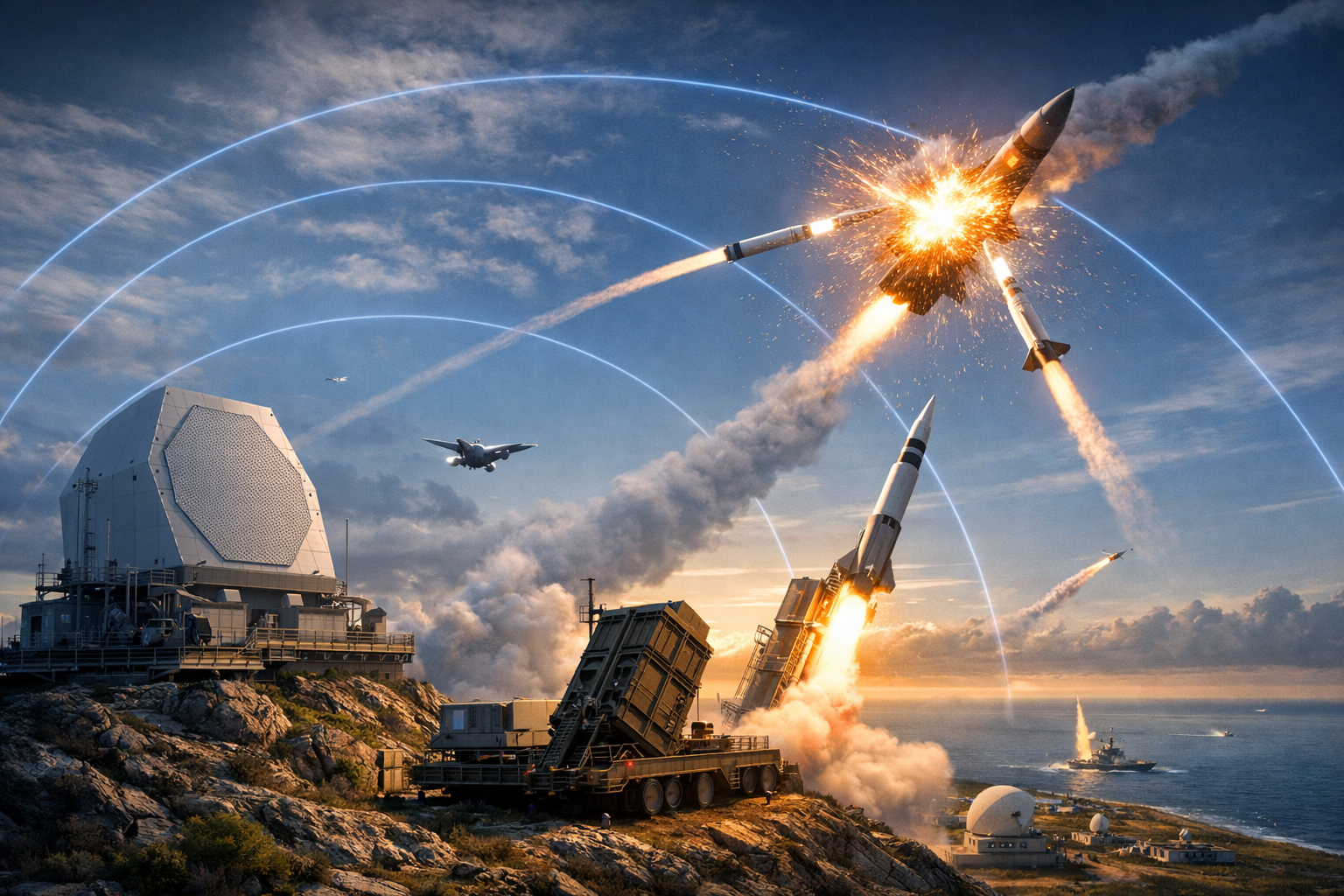
Missile defense systems are designed to detect, track, and intercept incoming missiles before they reach their intended targets. In modern warfare, these systems protect cities, military bases, and critical infrastructure from ballistic missiles, cruise missiles, rockets, and increasingly unmanned aerial threats.
Unlike traditional air defense designed primarily to counter aircraft, missile defense must respond to extremely fast-moving threats with minimal warning time. Ballistic missiles can travel at several kilometers per second, while modern cruise missiles and hypersonic weapons may approach targets at low altitude or with maneuvering flight paths.
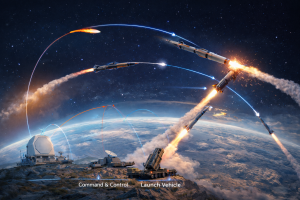
Because of these challenges, modern missile defense relies on layered interception architecture, combining sensors, command networks, and interceptor weapons operating at multiple phases of a missile’s flight.
This article explains how those systems function and how different missile defense platforms work together within a broader defensive network.
1. Detection and Tracking
Every missile defense architecture begins with early detection.
Missiles produce distinctive signatures during launch, particularly heat from rocket engines and radar reflections from their flight bodies. Modern missile defense networks use multiple sensor types to detect these signatures as early as possible.
These sensors typically include:
- Early warning satellites that detect infrared launch signatures
- Long-range ground-based radar systems
- Naval radar platforms integrated into fleet defenses
- Airborne surveillance systems
One of the most important radar technologies used in missile defense is high-resolution X-band radar, which can track ballistic missiles at long distances and distinguish real warheads from decoys.
Tracking systems continuously update the missile’s trajectory and calculate where it is likely to land. This information is then sent to command-and-control systems that determine whether interception is necessary.
Without accurate detection and tracking, missile defense is impossible.
2. Battle Management and Target Selection
Once a missile has been detected and tracked, command-and-control software evaluates the threat.
Modern missile defense networks use sophisticated battle management systems to analyze several key factors:
- Estimated impact location
- Missile type and trajectory
- Available interceptor coverage
- Engagement timing windows
If a missile is predicted to land in an uninhabited area or open terrain, interception may not be necessary. This selective engagement approach helps conserve interceptor missiles, which are expensive and limited in number.
If the missile threatens a protected area, the system assigns an interceptor from the most appropriate defensive layer.
Battle management systems are often networked across multiple platforms, enabling cooperative defense across large geographic areas.
3. Interception Phases
Missiles can be intercepted during three main phases of their flight.
Boost Phase
This phase occurs immediately after launch while the missile’s rocket engines are still firing.
Interception during boost phase is theoretically advantageous because the missile is large, slow relative to later stages, and highly visible due to engine heat.
However, this phase lasts only a few minutes and typically occurs over enemy territory, making interception difficult with current technology.
Midcourse Phase
The midcourse phase occurs when the missile travels through space after its booster stage separates.
At this point, the warhead and any decoys follow predictable ballistic trajectories. Interceptors launched during this phase attempt to collide with the warhead outside the atmosphere.
Some missile defense architectures focus heavily on midcourse interception because it provides a longer engagement window.
Terminal Phase
The terminal phase occurs as the missile re-enters the atmosphere and descends toward its target.
Many missile defense systems operate in this phase because it occurs closer to defended areas and provides more reliable targeting data.
However, interception windows are shorter, and the warhead is traveling at extremely high speeds.
4. Interceptor Technologies
Modern missile defense interceptors generally fall into two categories.
Hit-to-Kill Interceptors
These systems destroy incoming missiles through direct kinetic impact rather than explosive warheads.
A guidance system directs the interceptor to collide with the incoming warhead at extremely high speed. The energy of the collision alone is sufficient to destroy the target.
This approach increases precision and reduces the risk of unexploded warheads falling on defended areas.
Proximity-Detonation Interceptors
Some systems use explosive fragmentation warheads. These interceptors detonate near the target and destroy it through blast and shrapnel effects.
While effective against aircraft and some missile types, this method is less precise against high-speed ballistic threats.
5. Layered Missile Defense Architecture
Modern missile defense networks rarely rely on a single system. Instead, they employ layered defense, where different systems intercept threats at different ranges and altitudes.
This layered approach increases interception probability and provides multiple opportunities to destroy incoming missiles.
Several major systems form the backbone of modern missile defense:
Iron Dome
Designed to intercept short-range rockets and artillery shells. Iron Dome protects cities from saturation rocket attacks and uses selective engagement to conserve interceptors.
MIM-104 Patriot
A long-range air and missile defense system capable of intercepting aircraft, cruise missiles, and tactical ballistic missiles.
Terminal High Altitude Area Defense
Designed to intercept ballistic missiles at high altitude during their terminal phase using hit-to-kill technology.
David’s Sling
A medium-range interceptor designed to counter large rockets and short-range ballistic missiles, filling the gap between Iron Dome and higher-altitude defenses.
Aegis Ballistic Missile Defense
A sea-based missile defense architecture deployed on naval destroyers and cruisers. It uses the SM-3 and SM-6 interceptor families to engage ballistic missiles during midcourse or terminal phases.
Together, these systems form a multi-layered defensive network capable of addressing threats across different ranges and flight profiles.
Strategic Importance of Missile Defense
Missile defense has become a critical component of national security in an era of widespread missile proliferation.
Ballistic missiles, cruise missiles, and long-range strike systems are now possessed by numerous state and non-state actors. Missile defense systems help reduce vulnerability to these threats and strengthen deterrence by complicating adversary strike planning.
However, missile defense systems cannot guarantee complete protection. Large missile salvos, advanced maneuvering warheads, and hypersonic weapons remain significant challenges.
Instead, the strategic value of missile defense lies in risk reduction. By intercepting incoming threats and reducing potential damage, these systems provide political leaders and military commanders with greater decision-making flexibility during crises.
In modern warfare, missile defense is no longer a single system but a networked architecture of sensors, interceptors, and command systems working together to defend against increasingly complex aerial threats.
No responses yet