
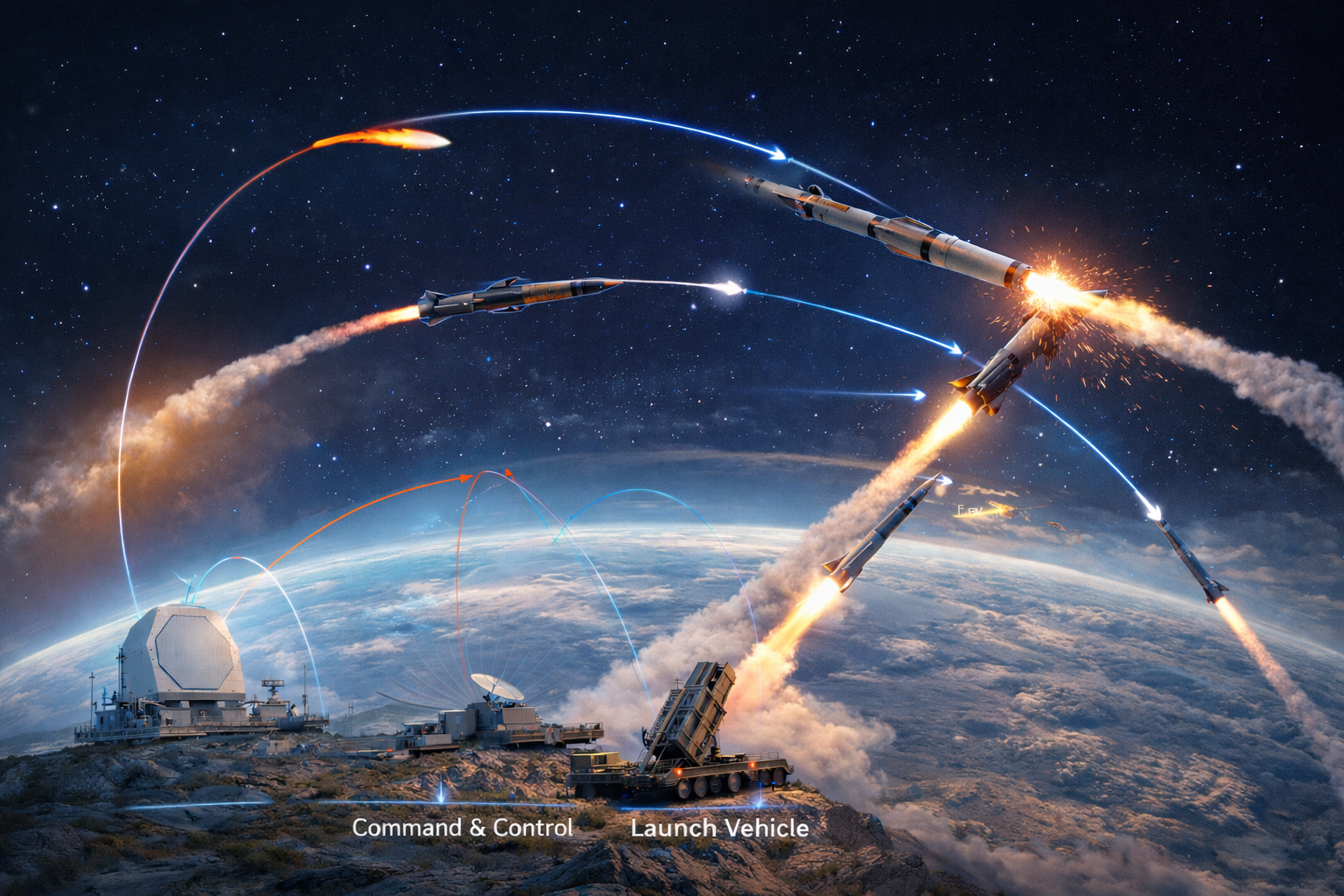
The Arrow missile defense system is a long-range ballistic missile defense architecture developed jointly by Israel Aerospace Industries and the Israel Missile Defense Organization, with significant support from the United States.
The system is designed to intercept ballistic missiles at high altitude, often outside the Earth’s atmosphere, before they can reach populated areas or strategic infrastructure.
Arrow is a central component of Israel’s multi-layer missile defense architecture, which also includes systems such as David’s Sling and Iron Dome.
This article explains how the Arrow system works—from the moment a missile is detected to the final interception in space.
1. Radar Detection
The first stage of missile defense is early detection.
The Arrow system relies heavily on the EL/M-2080 Green Pine Radar, a powerful long-range radar capable of detecting ballistic missile launches hundreds of kilometers away.
When an adversary launches a ballistic missile, the rocket engine generates a strong radar and infrared signature. The radar detects the missile shortly after launch and begins tracking its trajectory.
The radar system determines several key variables:
- Launch location
- Speed and altitude
- Flight trajectory
- Estimated impact zone
These calculations allow the missile defense network to determine whether the missile poses a threat to defended territory.
Because ballistic missiles follow predictable physics-based trajectories once their booster stage ends, early radar detection provides valuable time for defensive response.
2. Target Tracking
After initial detection, the Arrow system enters the tracking and threat analysis phase.
Radar systems continuously track the incoming missile and transmit data to the battle management command center. This command system evaluates whether the missile is likely to strike a defended area.
Key tasks during this phase include:
- Discriminating the warhead from debris or decoys
- Calculating predicted impact location
- Determining optimal interception timing
- Assigning an interceptor missile
The system must also calculate the interception window, which is the moment when the interceptor has the highest probability of successfully colliding with the incoming warhead.
Because ballistic missiles can travel at speeds exceeding several kilometers per second, the tracking and decision process occurs extremely quickly.
3. Interceptor Launch
Once the system confirms that interception is necessary, an interceptor missile is launched.
The current operational interceptor is the Arrow 3, which is designed to destroy incoming ballistic missiles outside the Earth’s atmosphere.
Arrow interceptors launch vertically from ground-based launcher systems using solid-fuel rocket boosters. The missile accelerates rapidly and begins climbing toward the predicted intercept point.
During the initial phase of flight, the interceptor receives guidance updates from ground radar and command systems. These updates adjust the interceptor’s trajectory to account for any changes in the target’s path.
As the interceptor approaches space, it prepares to deploy its kill vehicle for the final engagement phase.
4. Exo-Atmospheric Interception
The defining capability of the Arrow system is exo-atmospheric interception—destroying missiles in space before they reenter the atmosphere.
Once outside the atmosphere, the interceptor’s kill vehicle separates and uses onboard sensors to locate the incoming warhead.
The Arrow 3 interceptor uses hit-to-kill kinetic impact rather than explosive warheads. The kill vehicle maneuvers using small thrusters and guidance systems to collide directly with the incoming missile.
At closing speeds of several kilometers per second, the kinetic energy of the collision is sufficient to destroy the warhead.
Intercepting a ballistic missile in space provides several advantages:
- Debris burns up in the atmosphere before reaching the ground
- Warhead destruction occurs far from populated areas
- Multiple interception attempts remain possible if the first attempt fails
In some cases, missile defense systems may launch multiple interceptors to increase the probability of successful interception.
Strategic Importance of the Arrow System
The Arrow missile defense system plays a crucial role in defending against long-range ballistic missile threats.
Unlike short-range rocket defense systems, Arrow is designed to intercept missiles launched from hundreds or even thousands of kilometers away.
By destroying missiles in space, the system provides an early defensive layer before other systems—such as David’s Sling or Iron Dome—engage remaining threats.
Strategically, this layered approach significantly reduces vulnerability to missile attacks.
While no missile defense system can guarantee complete protection, Arrow increases the uncertainty and cost of missile strikes for potential adversaries.
In modern missile warfare, this capability contributes directly to deterrence and national resilience, ensuring that ballistic missile attacks are far less likely to achieve their intended strategic effect.



Comments are closed