

Autonomous warfare systems are transforming modern military operations. Advances in artificial intelligence, sensor fusion, and unmanned platforms allow military systems to detect, track, and engage targets with increasing levels of automation.
These systems include autonomous drones, loitering munitions, and AI-driven battlefield decision systems.
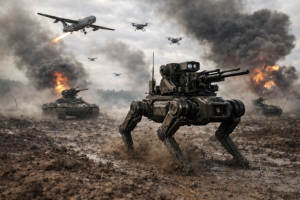
Rather than relying solely on human-operated platforms, modern militaries increasingly deploy systems capable of navigating, identifying threats, and executing missions with limited direct human control. These capabilities allow forces to operate in contested environments, extend operational reach, and reduce risk to personnel.
Autonomous warfare technologies are therefore becoming a central component of future military doctrine across air, land, maritime, and cyber domains.
What Defines an Autonomous Military System
An autonomous military system is characterized by its ability to perform operational tasks without continuous human control. While many systems still operate under human supervision, increasing levels of automation allow machines to execute complex tasks independently.
Several key technologies define these systems.
Autonomous Navigation
Autonomous navigation allows unmanned platforms to move through the environment without constant human guidance.
Using GPS, inertial navigation systems, terrain mapping, and onboard sensors, autonomous vehicles can plan routes, avoid obstacles, and maintain flight paths.
In contested environments where GPS may be disrupted, advanced systems can rely on visual navigation, radar mapping, or preloaded terrain models to maintain operational capability.
Target Recognition
Target recognition systems use machine learning algorithms and onboard sensors to identify objects of interest.
Electro-optical cameras, infrared sensors, radar systems, and lidar scanners collect environmental data. Artificial intelligence models analyze this information to detect vehicles, aircraft, infrastructure, or personnel.
These recognition systems help operators identify potential threats quickly and can assist in selecting targets during combat operations.
Decision-Support Systems
Autonomous warfare platforms frequently incorporate AI-based decision-support systems.
These systems analyze sensor data, threat assessments, and mission objectives to recommend actions such as route adjustments, engagement timing, or defensive maneuvers.
In most operational environments, humans remain responsible for final engagement authorization, but automation significantly accelerates the decision-making process.
Sensor Fusion
Sensor fusion is the process of combining data from multiple sensors into a single operational picture.
For example, a drone may simultaneously use radar, infrared imaging, and satellite navigation data. By integrating these inputs, the system produces a more accurate understanding of the environment than any individual sensor could provide.
Sensor fusion is essential for reliable autonomous operation, particularly in complex battlefield environments where conditions change rapidly.
Types of Autonomous Warfare Systems
Autonomous military technologies appear across several platform categories.
Unmanned Aerial Vehicles (UAVs)
Unmanned aerial vehicles are the most widely deployed autonomous military systems.
UAVs perform missions including surveillance, reconnaissance, precision strike, and electronic warfare. Modern UAVs incorporate varying levels of autonomy, ranging from automated flight stabilization to advanced mission execution capabilities.
These aircraft extend operational reach and allow continuous monitoring of contested regions.
Drone Swarms
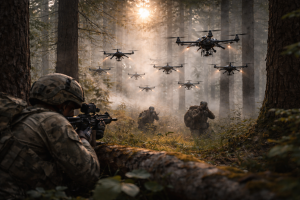
Drone swarm systems involve large numbers of unmanned vehicles operating cooperatively.
Using distributed algorithms and networked communications, swarm drones coordinate movements and missions collectively. This approach allows forces to overwhelm defenses through numerical saturation or conduct large-area reconnaissance.
Swarm warfare represents a shift toward distributed, scalable combat capabilities.
Loitering Munitions
Loitering munitions are autonomous or semi-autonomous weapons that remain airborne while searching for targets before striking.
Unlike traditional missiles, these systems can wait for optimal engagement conditions and may receive targeting updates from operators during flight.
Their flexibility makes them effective against mobile or time-sensitive targets.
AI Battlefield Command Systems
Beyond physical platforms, autonomous technologies are also transforming battlefield command systems.
AI-powered decision platforms can process large volumes of sensor data, identify emerging threats, and provide commanders with rapid recommendations.
These systems help reduce decision cycles in complex operational environments.
Key Autonomous Warfare Systems
Several systems illustrate how autonomous technologies are being integrated into modern military operations.
LUCAS
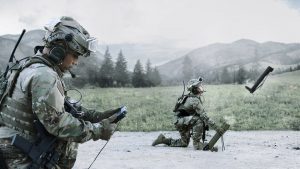
The LUCAS one-way attack drone represents the growing role of expendable autonomous strike systems. Designed for long-range loitering and precision strike, it demonstrates how low-cost drones can be used to saturate defenses and attack high-value targets.
MQ-9 Reaper
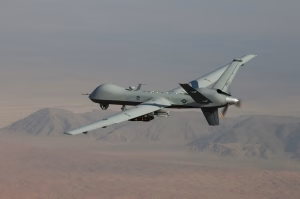
The MQ-9 Reaper is one of the most widely deployed unmanned combat aircraft. While primarily remotely piloted, it incorporates advanced automation for navigation, sensor operation, and targeting support.
Reaper platforms conduct intelligence, surveillance, and precision strike missions across multiple theaters.
Drone Swarm Warfare Systems
Drone swarm technologies demonstrate how autonomous coordination can multiply combat effectiveness.
By deploying large numbers of low-cost drones operating collaboratively, militaries can conduct reconnaissance, suppress air defenses, or perform distributed strike operations.
AI Battlefield Decision Systems
Artificial intelligence command platforms analyze large volumes of sensor and intelligence data to support operational decision-making.
These systems can identify patterns, predict potential threats, and assist commanders in allocating resources across complex battlefields.
The Future of Autonomous Warfare
Autonomous warfare systems represent one of the most significant technological shifts in modern military doctrine.
As artificial intelligence, robotics, and sensor technologies continue to evolve, military forces will increasingly rely on systems capable of operating independently in complex and contested environments.
These technologies promise greater operational reach, faster decision cycles, and scalable combat capabilities.
However, they also introduce new challenges—including ethical considerations, cybersecurity risks, and the need for robust human oversight.
Understanding autonomous warfare systems is therefore essential to understanding the future of modern military conflict.
Comments are closed