
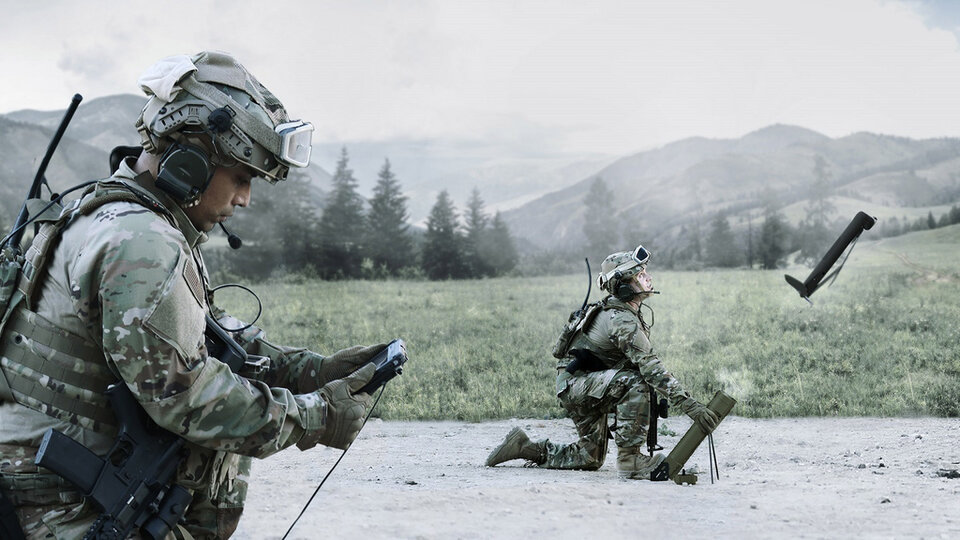
Loitering munitions are a class of unmanned weapon systems that combine the characteristics of drones and missiles. Unlike traditional missiles that are launched directly at a target, loitering munitions can remain airborne over a target area, search for threats, and strike when optimal conditions are met.
These systems are often referred to as “one-way attack drones” because they are expended upon impact, delivering their warhead directly to the target.
Loitering munitions have become increasingly prominent in modern conflicts due to their flexibility, precision, and relatively low cost compared to traditional precision-guided weapons.
1. Technology & Design
Loitering munitions are designed around three core functions: flight endurance, target detection, and terminal strike capability.
Most systems use lightweight airframes with either fixed-wing or rotary configurations. Fixed-wing designs are optimized for range and endurance, while rotary systems offer greater maneuverability and vertical launch capability.
Propulsion typically consists of electric motors for short-range systems or small combustion engines for longer-range platforms.
The onboard sensor suite usually includes:
- Electro-optical cameras
- Infrared imaging systems
- GPS and inertial navigation systems
These sensors allow operators to monitor the battlefield in real time and identify targets.
Guidance is provided through a combination of pre-programmed navigation and operator control via data link. Many systems also incorporate semi-autonomous targeting assistance, where onboard software helps identify potential targets.
The warhead is integrated into the airframe, turning the entire platform into a precision-guided weapon. Payload types vary depending on mission requirements and may include:
- Anti-personnel fragmentation
- Anti-armor shaped charges
- High-explosive blast effects
Launch systems range from portable tubes for infantry use to vehicle-mounted or containerized launch platforms.
2. Role & Battlefield Function
Loitering munitions operate primarily at the tactical level, though their operational impact can extend across wider battlefields.
Their primary role is precision strike against time-sensitive or mobile targets. Unlike artillery or pre-programmed missiles, loitering munitions allow operators to confirm targets before engagement.
Typical mission profiles include:
- Targeting armored vehicles and artillery positions
- Striking enemy personnel or fortified positions
- Suppression of air defense systems
- Close support for infantry units
Because they can loiter over an area, these systems are particularly effective against targets that appear unpredictably or relocate frequently.
Loitering munitions also reduce the time between detection and engagement, enabling rapid response to emerging threats.
They are widely used in both conventional and asymmetric warfare environments.
3. Capabilities & Limitations
The primary capability of loitering munitions is flexible precision engagement.
Operators can observe the battlefield in real time and decide when to strike, reducing the risk of targeting errors.
Compared to traditional missiles, loitering munitions provide greater control over engagement timing and target selection.
Their relatively low cost allows deployment in larger numbers, increasing operational flexibility.
They are also portable and can be deployed from forward positions without requiring large infrastructure.
However, limitations exist.
First, endurance is finite. Once fuel or battery power is exhausted, the system must either strike or be lost.
Second, payload size is limited compared to larger missile systems, restricting destructive capability.
Third, many systems rely on communication links for operator control, making them vulnerable to electronic warfare and signal jamming.
Fourth, survivability against advanced air defenses is limited, particularly for slower or low-altitude systems.
Finally, as expendable systems, they require continuous production and resupply.
4. Strategic Impact
Loitering munitions have significantly altered the dynamics of modern warfare.
They provide a cost-effective precision strike capability, allowing smaller units to engage targets that previously required artillery, aircraft, or missile systems.
Their use has expanded rapidly in recent conflicts, demonstrating their effectiveness against armored vehicles, artillery systems, and even air defense platforms.
Strategically, they contribute to the broader trend toward distributed and attritable warfare, where large numbers of low-cost systems are used to achieve cumulative effects.
This shift challenges traditional defense systems, which must adapt to handle large volumes of small, difficult-to-detect threats.
At the same time, countermeasures such as electronic warfare, directed energy weapons, and automated defense systems are evolving to address this threat.
In long-term perspective, loitering munitions represent a key component of the transition toward autonomous and semi-autonomous warfare systems, where precision strike capability is increasingly decentralized and scalable.



Comments are closed