
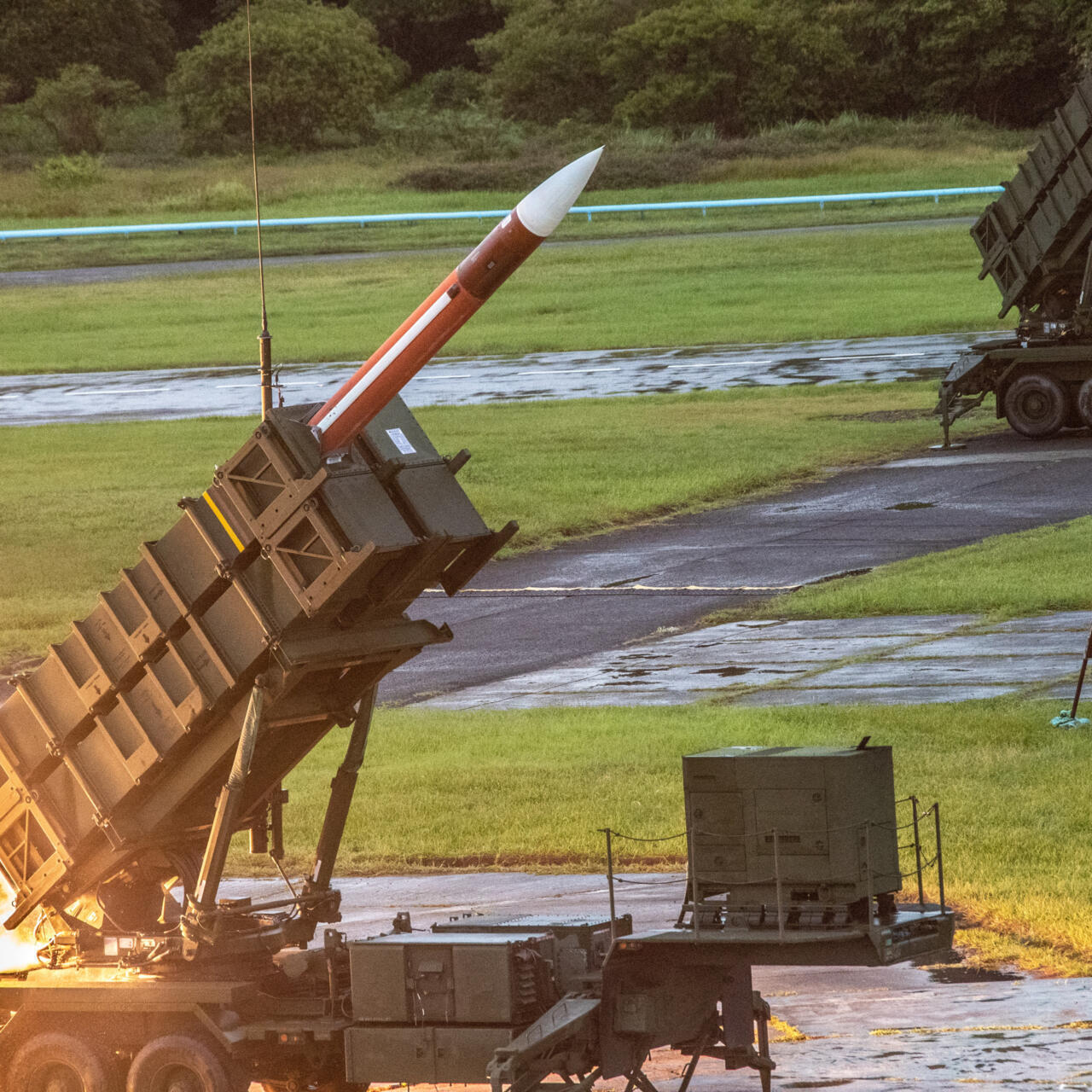
The MIM-104 Patriot is a long-range air and missile defense system developed by Raytheon Technologies and deployed by numerous allied nations. Originally introduced in the 1980s as an anti-aircraft system, Patriot has evolved into a multi-layered missile defense platform capable of intercepting aircraft, cruise missiles, and tactical ballistic missiles.
The system forms a core component of integrated air and missile defense architectures across NATO and allied forces.
1. Technology & Design
Patriot is a networked, ground-based air defense system composed of several integrated components: a phased-array radar, engagement control station, launcher units, interceptor missiles, and supporting power and communications vehicles.
The system’s central sensor is the AN/MPQ-65 Radar, a multifunction phased-array radar capable of search, target tracking, and missile guidance. Unlike mechanically rotating radars, the phased-array architecture electronically steers radar beams, allowing rapid simultaneous tracking of multiple targets.
The engagement control station functions as the command node for the battery, processing radar data, identifying threats, assigning interceptors, and coordinating engagement sequences.
Patriot launchers are trailer-mounted units capable of carrying multiple interceptor missiles. The number of missiles per launcher varies depending on interceptor type.
Two primary interceptor families are deployed:
- PAC-2 interceptors, designed primarily for aircraft and cruise missile interception.
- PAC-3 interceptors, optimized for ballistic missile defense using hit-to-kill kinetic impact technology.
PAC-3 missiles employ active radar seekers and highly maneuverable guidance systems, enabling precise terminal interception of high-speed targets.
Power generation and communications infrastructure are provided by mobile support vehicles, allowing the system to operate as a deployable field battery.
Patriot is designed for integration within larger air defense networks, sharing targeting data with external sensors such as early-warning radars, AWACS aircraft, and other missile defense systems.
2. Role & Battlefield Function
The Patriot system operates at the tactical and operational levels of air and missile defense.
Its primary mission is the protection of high-value assets against aerial threats, including:
- Tactical ballistic missiles
- Cruise missiles
- Aircraft
- Unmanned aerial systems
Typical defended assets include military bases, urban population centers, critical infrastructure, and forward operating positions.
Within an integrated air defense architecture, Patriot serves as a mid-to-long-range interceptor layer. It complements shorter-range systems such as NASAMS or SHORAD platforms and higher-tier systems designed for exo-atmospheric interception.
Deployment doctrine emphasizes layered defense and geographic coverage. Patriot batteries are positioned to protect critical nodes and create overlapping engagement zones.
In combat operations, the system functions as part of a broader sensor and command network, enabling coordinated engagements across multiple defense platforms.
The battlefield environment includes both conventional air warfare and missile strike scenarios, particularly in regions facing ballistic missile threats.
3. Capabilities & Limitations
The Patriot system’s principal capability is multi-threat interception within a single integrated platform.
The phased-array radar enables rapid target acquisition and simultaneous engagement of multiple incoming threats. This allows the system to defend against coordinated missile or aircraft attacks.
PAC-3 interceptors provide effective defense against short- and medium-range ballistic missiles through kinetic impact interception.
Mobility allows Patriot batteries to redeploy in response to evolving threat vectors, although deployment and setup require logistical preparation.
Integration with allied networks enhances situational awareness and cooperative engagement capabilities.
However, limitations remain.
First, coverage is geographically limited. Each battery defends a finite footprint, requiring multiple deployments to protect large areas.
Second, interceptor cost is high relative to many incoming threats. This creates cost-exchange challenges when facing inexpensive drones or rocket systems.
Third, saturation attacks remain a vulnerability. Large missile salvos can overwhelm interceptor inventories or engagement capacity.
Fourth, radar coverage is directional. Earlier Patriot radars provide primary coverage in a forward sector, requiring careful positioning or multiple systems for full 360-degree defense.
Fifth, ballistic missile interception success depends on engagement geometry and timing, particularly against maneuvering or hypersonic threats.
Finally, operational effectiveness relies heavily on integration with broader command-and-control networks.
4. Strategic Impact
Strategically, the Patriot system has become one of the most widely deployed Western air and missile defense platforms.
Its presence strengthens deterrence by reducing the effectiveness of adversary missile strikes against critical infrastructure and military installations.
For allied nations, Patriot provides a common defense architecture that enhances interoperability within NATO and coalition operations.
The system has also influenced the evolution of integrated air and missile defense doctrine. Modern defense strategies increasingly emphasize layered protection combining sensors, interceptors, and command networks.
However, the proliferation of advanced missiles—including hypersonic glide vehicles and maneuvering reentry vehicles—continues to challenge traditional missile defense systems.
Adversaries respond by developing more complex penetration aids, larger missile inventories, and multi-vector attack strategies.
In long-term strategic terms, Patriot illustrates both the strengths and limitations of ground-based missile defense. It significantly reduces vulnerability to limited missile attacks but cannot guarantee complete protection against large-scale salvos.
Its strategic value therefore lies in risk reduction and defense of critical assets rather than absolute shield capability.
As missile technology continues to evolve, systems like Patriot will remain central elements of integrated air defense networks, forming a key layer in the broader architecture of modern missile defense.
Related Missile Defense Systems
Modern missile defense relies on layered defensive systems, combining multiple interception technologies to counter different types of threats.



Comments are closed