
1. Technology & Design
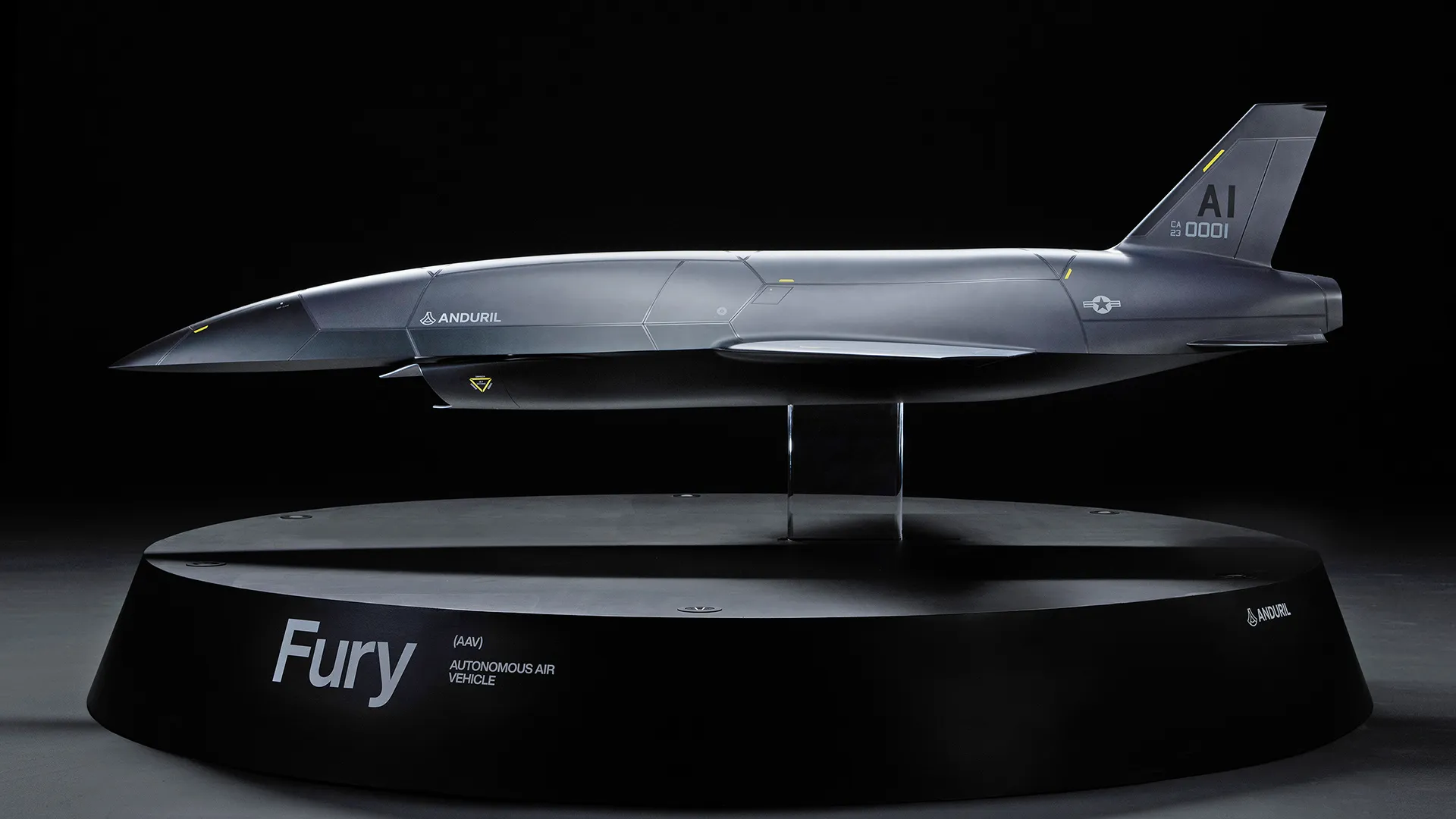
Fury is a high-performance autonomous air vehicle developed by Anduril Industries as part of a new class of software-defined, attritable combat aircraft. The system reflects a departure from traditional fighter procurement models, emphasizing autonomy, modularity, rapid manufacturing, and cost-controlled scalability over exquisite survivability.
Engineering philosophy centers on “autonomy-first” design. Rather than adapting a crewed aircraft to unmanned operation, Fury is purpose-built as an autonomous combat platform. The airframe is optimized for high-subsonic or transonic performance, internal payload carriage, and reduced radar cross-section, while eliminating cockpit-related constraints such as pilot life-support systems, ejection mechanisms, and canopy-induced signature penalties.
Structurally, Fury appears to incorporate composite construction with internal weapons bays to preserve aerodynamic efficiency and signature reduction. The configuration resembles a compact tactical jet with blended fuselage shaping, suggesting attention to radar cross-section management rather than full-spectrum stealth equivalence with fifth-generation fighters.
Propulsion details are not publicly disclosed in depth, but open-source assessments suggest a single turbofan engine optimized for endurance and dash capability rather than sustained supersonic flight. As an attritable platform, the design likely prioritizes reliability, maintainability, and unit cost control over extreme kinematic performance.
Power generation supports onboard computing, sensor suites, secure communications, and electronic warfare payloads. Given the system’s autonomy focus, onboard processing capacity is a critical design element. The aircraft must be capable of executing mission logic, sensor fusion, navigation, and threat response even in degraded communications environments.
Armament is modular. Fury is designed to carry air-to-air missiles, air-to-ground munitions, electronic warfare payloads, or ISR packages depending on mission configuration. Internal bays reduce drag and radar signature while preserving survivability in contested environments.
Sensor integration likely includes active electronically scanned array (AESA) radar, electro-optical/infrared systems, and passive detection capabilities. However, Anduril’s core differentiator is software integration via its Lattice AI platform, which enables distributed sensing, real-time decision support, and human-machine teaming.
Defensive systems are expected to include electronic warfare countermeasures and signature management rather than heavy armor. As an attritable asset, survivability is achieved through cost distribution and operational scale rather than extreme hardening.
2. Role & Battlefield Function
Fury’s primary role is as a collaborative combat aircraft (CCA) or “loyal wingman” operating alongside crewed fighters such as the F-35 Lightning II or F-22 Raptor.
At the tactical level, Fury extends the sensor and weapons reach of crewed platforms. It can conduct forward sensing, carry additional missile payload, perform electronic attack, or execute strike missions under supervisory control from a human operator.
Secondary roles include:
- Stand-in jamming within contested airspace
- Decoy and signature saturation operations
- ISR in high-risk environments
- Suppression of enemy air defenses (SEAD)
- Distributed air-to-air missile carrier
Operational doctrine envisions manned-unmanned teaming (MUM-T), where a single crewed aircraft controls multiple autonomous assets. Fury can operate semi-independently, executing mission objectives under rules of engagement defined pre-flight or updated in real time.
Within force hierarchy, Fury operates at the tactical and operational seam. It amplifies squadron-level lethality while contributing to theater-wide distributed kill chains.
The battlefield environment includes contested anti-access/area-denial zones, where risk to crewed aircraft must be minimized. Fury allows commanders to project combat power forward without directly exposing pilots to initial threat envelopes.
3. Capabilities & Limitations
Fury’s core capability is scalable combat mass. By fielding multiple lower-cost autonomous aircraft, a force can increase missile carriage, sensor coverage, and electronic warfare presence without proportionally increasing pilot training pipelines or sustainment overhead.
Autonomy reduces communication bandwidth requirements. The aircraft is designed to function with degraded or intermittent data links, mitigating vulnerability to jamming.
Attritability is central. Unlike high-end fighters costing upwards of $80 million per unit, Fury is intended to be comparatively lower cost, enabling risk-acceptant mission profiles. This shifts operational calculus from asset preservation to mission success.
Modular payload architecture provides flexibility across mission types. Software updates can adapt mission logic without major airframe redesign.
However, limitations are inherent.
First, autonomy reliability remains a developing field. Even advanced AI-driven decision systems require human oversight in lethal operations. Rules of engagement, ethical constraints, and fail-safe mechanisms complicate full autonomy.
Second, survivability is relative. Fury is not designed to match the full-spectrum stealth and kinematic performance of premier fifth-generation fighters. In dense integrated air defense systems, attrition rates may be non-trivial.
Third, electronic warfare dependency presents risk. If communications are fully denied and onboard autonomy cannot adapt to unexpected threat changes, mission effectiveness may degrade.
Fourth, industrial scalability is unproven at large combat fleet levels. Rapid manufacturing promises must translate into sustained production capacity under wartime conditions.
Finally, integration complexity is significant. Effective employment requires secure networking, joint interoperability, and doctrinal adaptation within air forces accustomed to crewed dominance.
4. Strategic Impact
Strategically, Fury represents a structural shift in airpower doctrine from platform-centric superiority to distributed autonomous mass.
By lowering unit cost and removing pilot risk from forward-edge operations, autonomous combat aircraft alter escalation dynamics. States can employ force in contested environments with reduced political and personnel risk, potentially lowering the threshold for limited engagements.
Deterrence value emerges from scale and uncertainty. An adversary facing dozens of autonomous aircraft—each capable of carrying advanced munitions—must account for distributed threats rather than a small number of exquisite fighters.
Doctrinally, Fury supports a transition toward software-defined warfare. Upgrades occur through algorithm refinement rather than airframe replacement cycles. This compresses innovation timelines and challenges traditional defense procurement models.
In alliance contexts, lower-cost autonomous platforms may enable broader force participation among partner nations lacking resources for large fleets of high-end crewed fighters.
However, the proliferation of autonomous strike systems may accelerate counter-AI and electronic warfare investments. Strategic competition will increasingly center on data superiority, resilient networks, and algorithmic decision advantage.
In long-term perspective, Anduril’s Fury is not merely another unmanned aerial vehicle. It represents an attempt to redefine tactical airpower economics—shifting from scarcity of elite platforms toward distributed, software-enabled combat ecosystems.
If successfully integrated at scale, Fury and similar systems could reshape the balance between manned and unmanned aviation, redefining how air superiority is achieved in contested 21st-century battlespaces.
Comments are closed