
1. Technology & Design
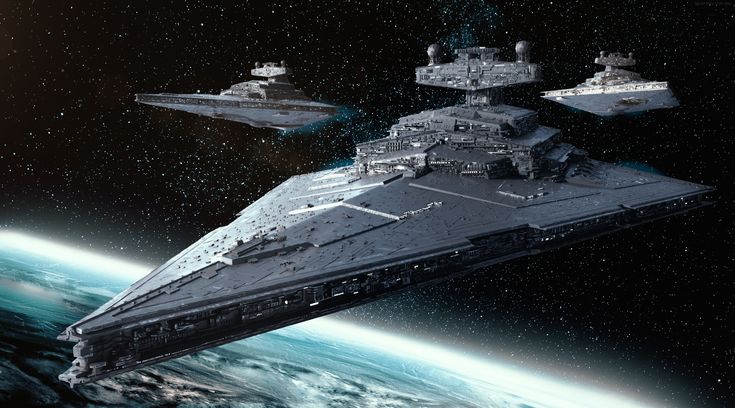
The Imperial-class Star Destroyer is the principal capital warship of the Galactic Empire and the doctrinal successor to the Republic’s Venator-class. Designed and produced by Kuat Drive Yards, the Imperial-class reflects a strategic shift from carrier-centric fleet operations to centralized heavy firepower and psychological dominance.
At approximately 1,600 meters in length, the Imperial-class represents a substantial increase in mass, volume, and combat capability over its predecessor. The wedge-shaped hull form is retained but enlarged, optimized for forward fire concentration and internal volumetric efficiency. The superstructure tower rises prominently above the dorsal surface, housing the primary command bridge and long-range sensor globes.
Structurally, the vessel is constructed around a reinforced durasteel frame with armored hull plating. The geometry is not optimized for stealth but for intimidation and forward-oriented combat geometry. Internal compartmentalization supports massive reactor cores, heavy turbolaser emplacements, stormtrooper complements, TIE fighter hangars, and ground assault vehicles.
Propulsion is provided by three primary ion engines supplemented by secondary thrusters for maneuvering. While not exceptionally agile for its size, the ship maintains sufficient sublight speed to maneuver in fleet engagements. A Class 2 hyperdrive (in standard Imperial I configuration) enables strategic mobility across the galaxy, supported by a backup hyperdrive for redundancy.
Power generation is derived from a large central reactor core capable of sustaining extensive deflector shield projection and heavy weapons fire. The ship’s energy budget prioritizes shield strength and turbolaser output, enabling sustained engagement in capital ship duels.
Armament is extensive and emphasizes ship-to-ship dominance. Standard Imperial I configurations include:
- Heavy turbolaser batteries for long-range capital engagements
- Ion cannons for shield disruption
- Point-defense laser cannons for anti-starfighter protection
- Tractor beam projectors for interdiction and capture
Unlike the Venator, the Imperial-class reduces relative emphasis on fighter operations. While it carries a TIE fighter wing (typically 72 craft in many sources), its primary lethality derives from its own guns rather than carrier-based strike power.
Sensor systems are integrated into the command tower’s shielded globes, providing long-range detection, targeting, and fleet coordination. Communications arrays allow sector-level command authority.
Defensive systems rely on powerful deflector shields, armored hull plating, and internal redundancy. However, critical subsystems—most notably the shield generators mounted atop the bridge tower—represent exposed vulnerabilities.
2. Role & Battlefield Function
The Imperial-class Star Destroyer functions as a multi-role capital ship operating at both operational and strategic levels.
Its primary role is sector control and force projection. A single Imperial-class vessel can:
- Enforce planetary blockade
- Deliver orbital bombardment
- Deploy stormtrooper legions
- Conduct fleet engagements
- Serve as mobile command headquarters
Within Imperial doctrine, the ship embodies centralized authority. Unlike Republic-era distributed fighter doctrine, the Empire favors concentrated capital ship presence to enforce compliance through visible dominance.
Operationally, the Imperial-class often operates independently or in small task groups. In less contested systems, a single Star Destroyer is sufficient to maintain order. In major fleet actions, multiple vessels operate in line formations to maximize overlapping fields of turbolaser fire.
Secondary roles include:
- Anti-piracy operations
- Rebel suppression
- Convoy escort
- Interdiction support
The vessel’s onboard troop capacity enables rapid planetary assault operations. Combined with landing craft and ground vehicles, it serves as a vertically integrated invasion platform.
The battlefield environment includes deep space, planetary orbit, and contested fleet theaters. Its doctrine assumes superiority in heavy ship engagements rather than reliance on dispersed aerospace warfare.
3. Capabilities & Limitations
The Imperial-class possesses overwhelming firepower relative to most cruisers and frigates. Its heavy turbolaser arrays enable sustained bombardment and effective capital ship dueling.
Deflector shields provide substantial resilience against standard energy weapons. Hull thickness and internal redundancy allow the vessel to absorb significant punishment before catastrophic failure.
Its troop capacity and fighter complement grant operational flexibility, enabling both space and ground force projection.
Strategically, hyperdrive mobility ensures rapid reinforcement capability across Imperial territory.
However, limitations are significant.
First, the command tower configuration creates a critical vulnerability. The shield generators mounted on exposed towers have proven susceptible to concentrated attack. Loss of shield projection dramatically reduces survivability.
Second, fighter doctrine is comparatively underdeveloped. TIE fighters lack hyperdrives and heavy shielding, making them dependent on the mothership and vulnerable to advanced Rebel starfighters.
Third, size reduces maneuverability. In close-quarters fleet engagements, smaller, more agile vessels can exploit firing arcs and structural blind spots.
Fourth, concentration of command authority aboard a single vessel creates strategic risk. Destruction of a Star Destroyer carries both operational and symbolic consequences.
Fifth, logistical requirements are substantial. Crewing levels exceed 30,000 personnel in many sources, requiring extensive support infrastructure.
Finally, its intimidation-based doctrine may encourage overreliance on shock and suppression rather than adaptive tactics. In asymmetric warfare environments, this rigidity becomes exploitable.
4. Strategic Impact
The Imperial-class Star Destroyer is less a ship and more an instrument of regime enforcement.
Strategically, it reinforces the Empire’s doctrine of centralized power projection. The visible presence of a wedge-shaped destroyer in orbit signals immediate compliance expectations. Its ability to conduct orbital bombardment underpins deterrence through punishment.
However, this same centralization creates high-value targets for insurgent forces. The destruction of even a single Imperial-class vessel carries disproportionate psychological and propaganda effects, as demonstrated in major fleet engagements.
Doctrinally, the shift from the Republic’s fighter-heavy Venator to the gun-dominant Imperial-class reflects a political transition. The Empire prioritizes order and intimidation over distributed adaptability.
In large-scale fleet warfare, the Imperial-class remains formidable. In counterinsurgency and asymmetric conflict, its scale and rigidity may be less effective.
Long-term, the Imperial Star Destroyer becomes synonymous with Imperial rule itself. Its strategic value lies not only in combat capability but in presence, visibility, and symbolic dominance.
Within the Star Wars strategic framework, the Imperial-class defines the Empire’s naval identity: centralized, powerful, and overtly imposing—capable of controlling star systems through concentrated firepower, but vulnerable where flexibility and distributed resilience are required.
Comments are closed