
1. Technology & Design
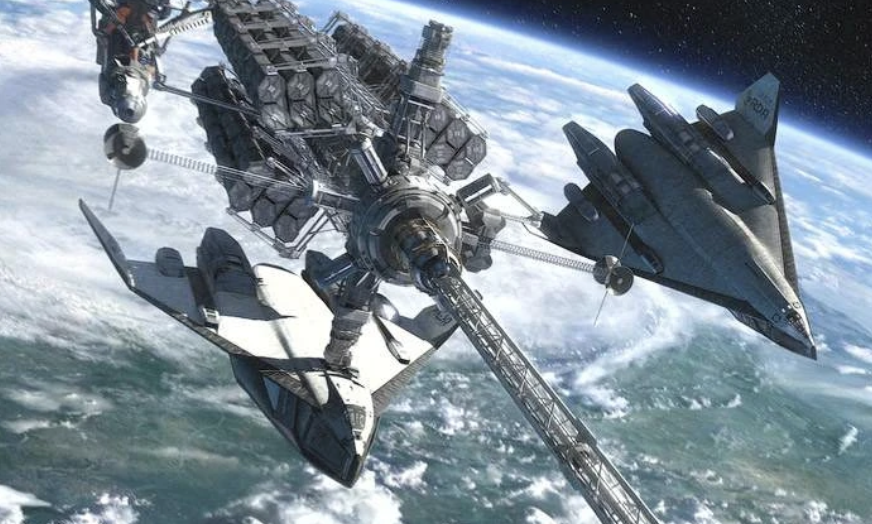
The RDA Valkyrie is presented as a trans-atmospheric vehicle (TAV) optimized for routine surface–orbit logistics on Pandora, bridging the orbital interstellar vehicle (ISV) and ground infrastructure such as Hell’s Gate. In design terms, it combines spacecraft-level ascent capability with aircraft-like operational tempo, prioritizing high sortie rates, repeatability, and heavy cargo throughput over specialized combat performance.
Structurally, the published canon emphasizes extensive use of high-strength, non-metallic composites, with carbon-nanotube composite reinforcement in key load paths to reduce mass while preserving stiffness and stability. The explicit comparison is to “permalloy” baselines, with the Valkyrie’s fuselage material described as weighing less than a quarter of comparable metallic solutions—implying a doctrine of mass minimization to improve ascent performance and propellant economy.
Propulsion is characterized as a “dual-mode fusion engine,” enabling rapid transition from atmospheric operations to powered ascent and orbital maneuvering. In-universe, this is the critical enabling technology: a compact, high-power energy source that supports single-stage-to-orbit performance without the fragile margins typical of chemical SSTO concepts. The platform’s stated capability—surface to orbit in under ten minutes at full burn—indicates extremely high thrust-to-weight performance during ascent, and correspondingly high thermal and structural loads during atmospheric flight and transonic/hypersonic regimes.
Power generation is effectively subsumed into the fusion architecture. Beyond propulsion, a fusion system plausibly supports high electrical power availability for onboard systems: avionics, flight control actuation, environmental control, cargo handling, and (if fitted) defensive countermeasures or directed-energy subsystems. Canon material does not specify these subsystems in detail, so any discussion of specific power distribution architecture (e.g., superconducting busses, capacitor banks) remains inferential rather than documented.
Armament is not intrinsic in the baseline configuration. However, the Valkyrie is described in reference material as able to mount optional dorsal hardpoints for crewed “Hydra machinegun nests” or automated turrets, suggesting a modular approach to self-protection rather than a dedicated gunship doctrine. This is consistent with a high-value logistics platform operating in contested or uncertain environments, where limited defensive fire is intended to deter light threats rather than defeat integrated air defense.
Sensors and networking are only described at a high level. The vehicle’s mission—transporting personnel, supplies, specialized electronics, and refined unobtanium—implies robust navigation, precision landing aids, and secure communications for coordination with orbital assets and ground control. The published text notes carriage of specialized electronic equipment for scientific or military purposes, implying the cargo bay can accommodate mission modules rather than the shuttle itself being a fixed ISR platform.
Defensively, the core design defense is performance and structure: rapid climb-out, high energy margins, and a lightweight but strong airframe. No formal stealth shaping, signature management suite, or layered countermeasure package is specified in canon references, and survivability should therefore be assessed as limited in a high-end threat environment.
2. Role & Battlefield Function
Operationally, the Valkyrie’s primary role is strategic logistics: routine movement of cargo and personnel between Pandora’s surface and orbiting ISVs. It is the final—and operationally decisive—link in the Earth–Pandora supply chain because it converts orbital transport capacity into usable ground presence and export throughput.
A key doctrinal function is outbound resource transfer. Canon material emphasizes that the platform’s “true strength” is shuttling large quantities of refined unobtanium from surface facilities to an orbiting ISV, positioning the vehicle as an economic-military enabler rather than merely a personnel transport. The ability to lift dense, valuable cargo to orbit underpins the RDA’s extractive strategy and, by extension, its security posture.
Secondary roles are opportunistic and mission-driven. The Valkyrie can deliver mixed loads—troops, supplies, and specialized equipment—supporting expeditionary basing, rapid reinforcement, and high-priority insertion. In the Battle of the Hallelujah Mountains, a Valkyrie was used as an improvised strike platform intended to deliver mining explosives against a fixed target, illustrating that commanders may repurpose a logistics shuttle in extremis when its lift capacity offers effects that conventional aircraft cannot provide.
Within a force hierarchy, the platform sits at the operational–strategic seam. Tactically it can deliver forces and matériel, but its true value is strategic mobility and sustainment. It integrates with orbital ISV operations (rendezvous/docking, cargo transfer) and with ground infrastructure (pads, ramps, handling equipment, security). The stated six-hour period to maneuver and dock after reaching orbit highlights that mission timelines are not only driven by ascent/descent but also by orbital phasing, traffic management, and docking procedures.
The battlefield environment is trans-atmospheric: it must tolerate both atmospheric flight and near-space conditions. That makes it a high-value asset whose employment would be tightly controlled—scheduled, escorted when possible, and protected by broader security measures rather than expected to “fight through” contested airspace.
3. Capabilities & Limitations
The clearest capability is rapid surface–orbit access. A sub–ten-minute surface-to-orbit profile, if taken at face value, implies the ability to surge logistics, reposition critical personnel, and evacuate high-value cargo rapidly. This speed compresses adversary decision cycles and reduces exposure time in vulnerable ascent corridors.
Payload flexibility is a second strength. The shuttle is explicitly described as carrying combinations of personnel, supplies, and specialized electronics, and as being optimized for bulk export of refined unobtanium. In practical terms, this suggests a large internal volume, cargo handling provisions, and modular load planning rather than a cabin-centric design.
Technological advantages center on materials and propulsion. Lightweight composite structure improves mass fraction and operating economics, while fusion propulsion removes many constraints that dominate chemical SSTO designs (propellant fraction, turnaround complexity, and limited delta-v margins).
Limitations are primarily survivability and operational dependency. First, the Valkyrie is not described as possessing dedicated penetration features (stealth, electronic warfare suites, robust countermeasures). Optional machinegun/turret fits may provide local defense against small airborne threats but are unlikely to be decisive against coordinated attacks or sophisticated air defense concepts.
Second, logistics shuttles create predictable patterns. Even with high speed, surface–orbit operations concentrate around known facilities: landing zones, approach corridors, and orbital rendezvous points. Unless the RDA fields multiple pads, decoys, and distributed infrastructure, an adversary can focus disruption efforts on these nodes. The six-hour orbit maneuver/docking phase further implies windows where the shuttle is committed to orbital geometry and less tactically flexible than its ascent time alone suggests.
Third, high-energy propulsion implies high maintenance and safety burden. Canon sources do not describe maintenance cycles, spares, or failure modes; however, a fusion-powered TAV would plausibly demand specialized technicians, containment integrity monitoring, and robust ground support equipment. In strategic terms, this makes the Valkyrie a critical vulnerability: losing even a small number could sharply constrain orbital throughput and surface sustainment.
Cost is not stated in canon sources, but the technology stack (fusion engine + advanced composites) strongly implies a high unit cost and a limited fleet, which increases operational risk concentration.
4. Strategic Impact
The Valkyrie reshapes the balance between orbital dominance and surface control. By making orbit-to-surface logistics routine and fast, it enables the RDA to translate interstellar lift into persistent planetary presence. This has direct deterrence value within the setting: it signals that RDA can reinforce, resupply, and extract resources at will so long as it controls orbital operations and protects its nodes.
Doctrinally, it supports an expeditionary “vertical sustainment” model: surface bases are not isolated outposts but extensions of orbital infrastructure. The ability to export refined unobtanium to an ISV also makes the shuttle a linchpin of political economy; disruption of Valkyrie operations is therefore strategically equivalent to disrupting the entire extraction enterprise.
Escalation potential is implicit. A platform that can be repurposed as an improvised heavy strike delivery system creates ambiguity: is a departing shuttle carrying cargo, reinforcements, or munitions? Even if not designed as a bomber, the demonstrated intent to use it that way in the Hallelujah Mountains indicates that adversaries may treat Valkyrie flights as potential strike sorties, increasing the likelihood of preemption and miscalculation.
In real-world doctrinal parallels, the Valkyrie is best understood as a heavy-lift rapid-response orbital shuttle concept—closer to a strategic airlift aircraft combined with a launch system than to a fighter or gunship. Its existence would push competitors toward counter-logistics strategies: denial of pads and depots, attacks on cargo handling capacity, and disruption of orbital rendezvous/docking—because destroying the shuttle’s freedom of movement is more decisive than defeating it in a symmetric “air battle.”
Long-term, the Valkyrie’s strategic effect is to compress distance. In a setting where interstellar transit is slow and expensive, the decisive contest becomes not travel time between stars but the ability to move mass efficiently between orbit and surface. On that axis, the Valkyrie is a central instrument of power projection—and a central point of failure if adversaries can impose sustained attrition on the orbital logistics chain.
Comments are closed