
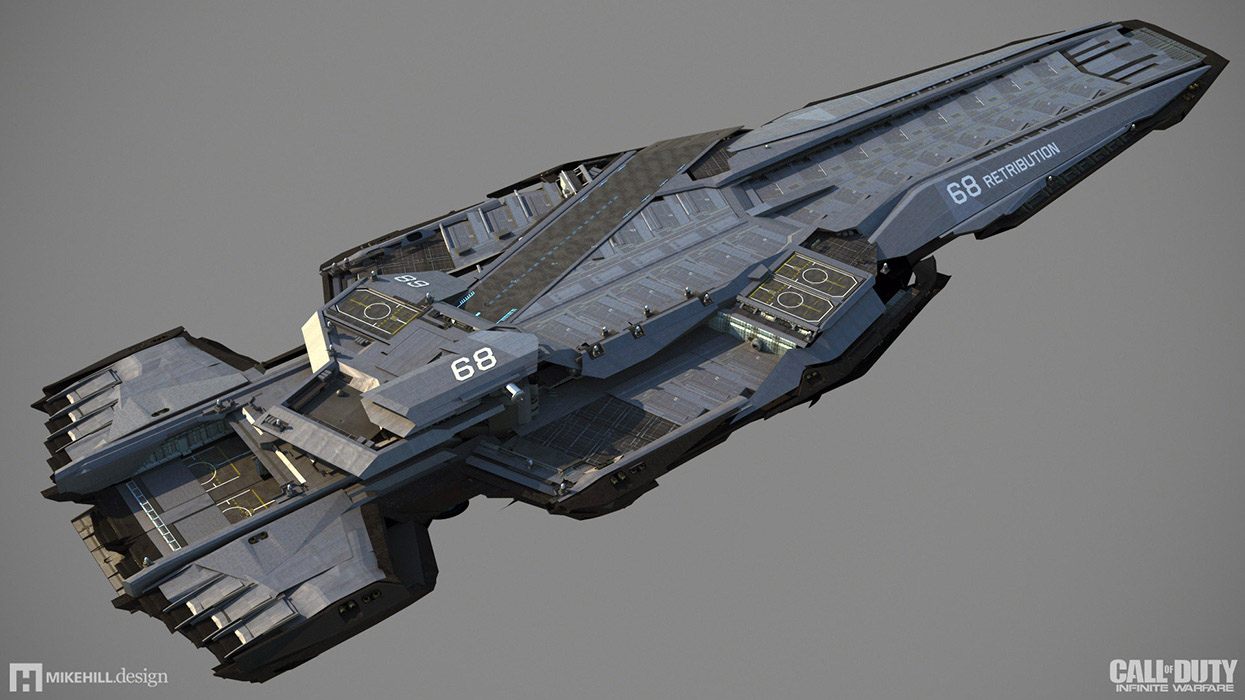
The UNSA Retribution is the primary capital warship of the United Nations Space Alliance (UNSA) in Call of Duty: Infinite Warfare. As a front-line space combatant operating in a near-future interplanetary conflict environment, the Retribution reflects a doctrine centered on carrier-based space superiority, expeditionary strike capability, and sustained fleet operations across the inner solar system.
1. Technology & Design
The Retribution is structured as a multi-role capital ship combining carrier, destroyer, and command ship functions into a single hull. The engineering philosophy reflects combined-arms space warfare: the vessel integrates fighter operations, heavy ship-based armament, troop deployment, and fleet coordination capabilities.
Structurally, the ship exhibits a reinforced armored hull optimized for kinetic and directed-energy exchanges in vacuum combat. Its configuration includes internal hangar bays for space superiority fighters (notably the Jackal-class), maintenance facilities, and launch systems for rapid sortie cycles. The presence of a sizable hangar indicates that aerospace strike capability is central to the vessel’s operational doctrine.
Propulsion is achieved via high-output fusion or advanced plasma drive systems (exact canonical reactor specifications are not detailed). The ship demonstrates high delta-v maneuver capability relative to its scale, allowing repositioning during fleet engagements and interplanetary transits.
Power generation supports heavy energy weapons, defensive shielding, propulsion, and onboard life-support systems. The energy architecture implies a central reactor core distributing power across modular combat systems. Redundancy is assumed given the vessel’s sustained combat endurance during major engagements.
Armament includes ship-mounted directed-energy cannons and missile systems designed for capital-ship engagements. These are complemented by point-defense systems to counter incoming fighters and missiles. The Retribution’s weapons mix indicates an ability to engage both peer warships and smaller strike craft.
Sensor arrays are integrated for deep-space tracking, targeting, and fleet coordination. In a solar-system-scale battlespace, long-range detection and targeting solutions are essential for effective engagement.
Defensive systems include armored hull plating and energy shielding. While not invulnerable, the vessel is designed to withstand sustained exchanges in fleet combat environments.
2. Role & Battlefield Function
The Retribution functions as a capital carrier-battleship hybrid and fleet flagship within UNSA doctrine. Its primary role is space superiority and interplanetary power projection.
At the operational level, the vessel serves as:
- Fleet command ship
- Fighter carrier
- Heavy strike platform
- Strategic deterrent asset
Its embarked Jackal fighters conduct reconnaissance, interception, strike missions, and escort operations. This distributed aerospace capability extends the ship’s engagement envelope far beyond its direct-fire weapon range.
Secondary roles include:
- Orbital blockade
- Troop insertion support
- Strategic strike coordination
- Interplanetary convoy escort
Within force hierarchy, the Retribution sits at the top tier of UNSA naval assets. It commands task groups and anchors fleet formations in major engagements.
Deployment doctrine emphasizes mobility across planetary orbits, asteroid belts, and deep-space corridors. The ship operates in vacuum environments, where maneuver, targeting precision, and reaction time determine survivability.
The battlespace is three-dimensional and long-range, with engagement distances significantly exceeding terrestrial naval combat analogs.
3. Capabilities & Limitations
The Retribution’s primary capability lies in integrated combat mass. By combining heavy ship weapons with embarked fighter wings, it delivers layered offensive power.
Its command-and-control infrastructure enables coordinated fleet operations. As a flagship, it integrates sensor data, strike tasking, and tactical adjustments in real time.
The carrier element enhances flexibility. Fighters extend reconnaissance reach, conduct precision strikes, and provide intercept coverage.
Durability is notable. The ship demonstrates sustained operational capacity despite heavy combat exposure.
However, limitations are evident.
First, as a high-value capital ship, it concentrates combat power in a single hull. Damage or destruction significantly degrades operational capability and morale.
Second, survivability depends on layered defense. Without fighter screen and escort vessels, it is vulnerable to massed missile or fighter assault.
Third, propulsion and energy demands create logistical constraints. Sustained operations across the solar system require secure refueling and resupply networks.
Fourth, maneuverability is limited relative to smaller warships and fighters. In close engagements, it relies on escorts and defensive systems to mitigate vulnerabilities.
Finally, its large crew complement increases life-support demands and casualty risk during hull breaches.
4. Strategic Impact
Strategically, the UNSA Retribution represents centralized interplanetary force projection. It serves as both military instrument and political symbol of UNSA authority.
In a fragmented solar-system conflict environment, possession of such capital ships defines strategic leverage. Their presence in orbit signals the ability to conduct blockade, strike, or invasion support.
Doctrinally, the Retribution reinforces a navalized model of space warfare—mirroring carrier battle group concepts from maritime history but scaled to orbital and deep-space operations.
However, concentration of force in large capital ships also introduces escalation dynamics. The destruction of a flagship has outsized political and strategic consequences.
Within the Infinite Warfare framework, the Retribution embodies high-end conventional space conflict: mobile, heavily armed, carrier-capable warships contesting orbital dominance.
In long-term strategic analysis, such vessels illustrate the tradeoff between centralized power projection and distributed survivability. While formidable in fleet engagements, their survivability depends on layered support and sustained logistical infrastructure.
The UNSA Retribution is therefore best understood as a capital force-multiplier—designed to project aerospace superiority across planetary theaters, but strategically vulnerable to attrition if adversaries can disrupt its escort network or exploit concentration risk.


Comments are closed