
1. Technology & Design
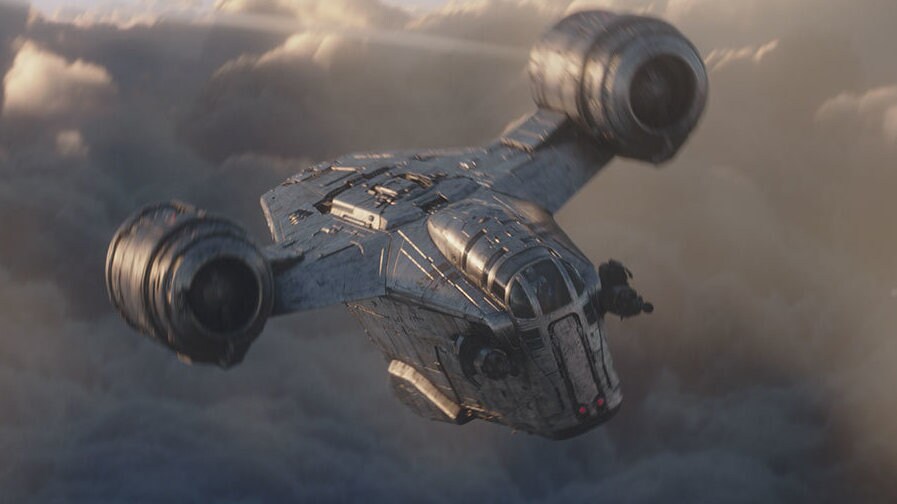
The Razor Crest is a pre-Empire ST-70 assault ship manufactured by the Crest Industries, later operated independently by Din Djarin in The Mandalorian. Originally conceived as a military patrol and gunship platform, the Razor Crest represents a ruggedized, modular light transport optimized for frontier operations rather than fleet integration.
The engineering philosophy emphasizes durability, maintainability, and autonomy. Unlike large naval capital ships or standardized Imperial starfighters, the Razor Crest is designed for independent operators in low-infrastructure environments. Structural construction appears heavy and utilitarian, with reinforced hull plating and minimal external aesthetic refinement—suggesting a focus on survivability and ease of repair over signature reduction.
Propulsion consists of twin main sublight engines mounted on extended nacelles, providing sufficient thrust for atmospheric flight and interplanetary maneuvering. The vessel is equipped with a hyperdrive system for long-range travel, though not described as high-speed relative to military interceptors. Maneuverability is adequate for evasion and pursuit in localized engagements but not optimized for sustained dogfighting against dedicated fighters.
Power generation supports life-support systems, carbonite freezing chambers (as modified by its operator), onboard weapons, and navigation arrays. While detailed reactor specifications are not provided in canon, the ship demonstrates sufficient energy output for sustained spaceflight and combat operations, albeit at a modest scale relative to capital ships.
Armament includes forward-facing laser cannons and missile launch capability. The configuration suggests limited but meaningful offensive capability—suitable for engagements against small craft, light freighters, or ground targets. The absence of heavy turbolasers or shield-penetrating weaponry indicates the platform was not designed for fleet combat.
Defensive systems include deflector shielding and reinforced hull plating. However, shielding strength appears moderate; the ship sustains damage under concentrated attack and lacks the layered defensive redundancy of larger military vessels.
Sensor systems appear standard for light assault craft—navigation radar, threat detection, and communications—but not optimized for long-range fleet command or advanced electronic warfare.
Internally, the ship is highly modular. The cargo hold accommodates bounties, equipment, and vehicle storage. The interior configuration reflects mission adaptability rather than standardized military layout.
2. Role & Battlefield Function
The Razor Crest’s primary role is independent patrol and assault transport. Originally designed for military service, its operational profile aligns with border security, reconnaissance, and small-scale engagement missions.
In civilian hands, its function evolves into that of a bounty hunter gunship—combining transport, detention, and strike capability within a single hull. This reflects its structural flexibility and endurance characteristics.
At the tactical level, the Razor Crest operates independently rather than as part of a formal fleet hierarchy. It is not integrated into task force doctrine or carrier-based deployment cycles. Instead, it supports decentralized operations in remote or under-governed regions.
Secondary roles include:
- Rapid insertion/extraction of personnel
- Light ground attack
- Escort duties for small convoys
- Surveillance and interdiction
Deployment doctrine emphasizes autonomy. The ship’s endurance and hyperdrive capability allow its operator to function far from centralized support structures.
The battlefield environment includes space engagements against light craft, atmospheric operations over rugged terrain, and operations within frontier systems. It is not suited for large-scale fleet warfare or high-intensity capital ship engagements.
3. Capabilities & Limitations
The Razor Crest’s primary capability is self-sufficiency. Its combination of hyperdrive, cargo capacity, weapons, and life-support systems allows extended independent missions.
Its rugged construction permits operation in harsh environments with limited support. This enhances survivability in frontier systems lacking established infrastructure.
The ship’s offensive capability is sufficient for small-scale engagements. Forward cannons and missiles allow credible deterrence against pirate craft or lightly armed transports.
Modularity enables mission-specific adaptation, including detention systems and equipment storage.
However, limitations are substantial.
First, survivability is limited against organized military opposition. The ship lacks heavy shielding, redundant reactor compartments, or advanced point-defense systems. Sustained attacks from multiple adversaries can overwhelm defenses.
Second, it lacks stealth or advanced electronic countermeasures, making it detectable and targetable by superior sensor platforms.
Third, crew capacity is minimal. With only one or two operators, redundancy in combat or damage control is limited.
Fourth, maintenance burden falls entirely on its operator. Without logistical backing, sustained combat readiness depends on access to repair facilities and spare parts.
Finally, its armament is insufficient against capital ships or coordinated squadrons of advanced starfighters.
4. Strategic Impact
Strategically, the Razor Crest does not alter galactic balance in conventional military terms. It is not a fleet asset nor a system-of-systems architecture. Its significance lies in decentralized power projection at the individual level.
Within the post-Imperial fragmentation context, such vessels enable private actors—bounty hunters, mercenaries, local security forces—to exercise limited force projection without reliance on centralized governments.
This decentralization reflects broader instability in the Outer Rim. Where Imperial or Republic naval presence is absent, platforms like the Razor Crest fill security vacuums.
Doctrinally, the ship represents legacy military hardware repurposed for non-state actors. Its existence illustrates how surplus or decommissioned military platforms can proliferate into gray-market or independent hands, influencing localized security dynamics.
From a strategic perspective, the Razor Crest embodies asymmetry. It is not decisive in fleet combat but is highly effective in low-intensity, decentralized conflict environments.
Its destruction underscores its structural vulnerability against organized military forces, reinforcing the reality that independent gunships cannot substitute for layered fleet defense.
In the broader Star Wars framework, the Razor Crest represents frontier-era adaptability: a durable assault transport enabling autonomy and mobility in contested but lightly governed systems—effective in small-scale engagements but strategically insignificant against centralized naval power.


Comments are closed