
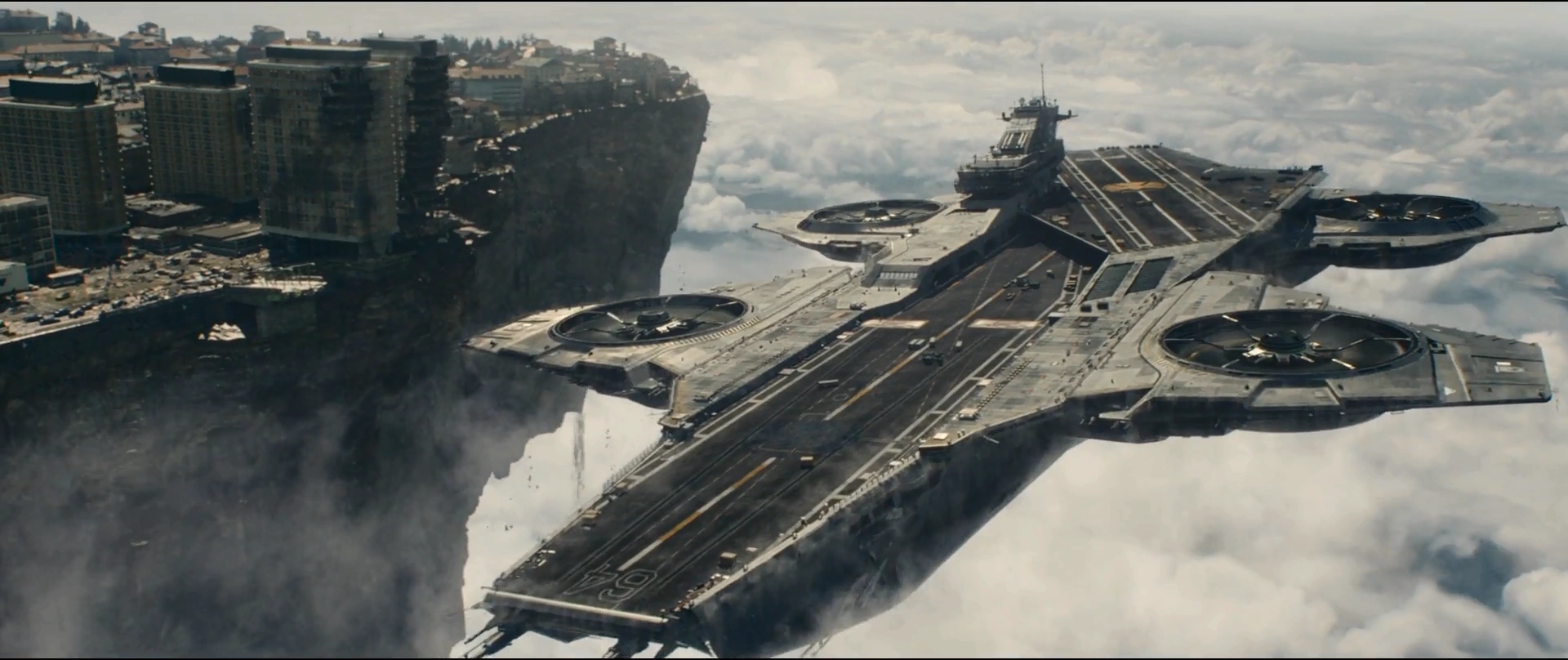
The Helicarrier, operated by S.H.I.E.L.D., is a strategic airborne command platform within the Marvel Cinematic Universe. It combines elements of an aircraft carrier, airborne early-warning platform, and global command-and-control node. Unlike conventional carriers constrained to maritime domains, the Helicarrier introduces persistent airborne basing with strategic mobility independent of fixed infrastructure.
1. Technology & Design
The Helicarrier’s defining engineering feature is sustained atmospheric flight of a super-heavy capital platform. Lift is achieved through multiple large-scale vertical propulsion assemblies—typically depicted as four massive turbine or rotor-driven lift units integrated into the hull structure. These systems provide distributed thrust sufficient to elevate and maneuver a structure comparable in scale to a naval supercarrier.
Structurally, the platform is built around a reinforced armored hull designed to withstand both kinetic and directed-energy threats. The architecture includes a full-length flight deck, internal hangars, command facilities, detention areas, and intelligence analysis centers. The hull’s geometry prioritizes aerodynamic stability and distributed mass balance rather than stealth shaping.
Power generation is implied to be advanced and high-density. Sustained lift of a carrier-scale structure requires continuous high-output energy production, likely derived from advanced reactor systems within the fictional setting. The energy architecture must simultaneously support propulsion, defensive systems, flight operations, onboard computing infrastructure, and life-support systems.
Armament varies by iteration but typically includes:
- Air-defense missile batteries
- Point-defense cannons
- Internal security systems
- In later variants, heavy long-range weapons
In certain depictions, the Helicarrier incorporates optical camouflage or cloaking technologies, enabling visual and radar concealment. This capability suggests advanced materials engineering and real-time environmental projection systems.
Sensor systems are extensive. As a strategic command node, the Helicarrier integrates global surveillance feeds, satellite links, radar arrays, and electronic intelligence systems. It functions as a flying fusion center for intelligence operations.
Defensively, the platform relies on layered systems: altitude, escort aircraft, onboard air defenses, structural reinforcement, and in some versions, stealth capabilities. However, given its size, survivability depends heavily on escort and early warning.
2. Role & Battlefield Function
The Helicarrier’s primary role is airborne strategic command and rapid-response deployment. It operates at the strategic level of conflict management rather than serving purely as a tactical weapons platform.
Core functions include:
- Mobile command-and-control headquarters
- Aircraft launch and recovery platform
- Rapid insertion of special operations units
- Persistent ISR hub
- Symbol of centralized authority
Unlike a maritime carrier that projects power from international waters, the Helicarrier can position itself directly over areas of interest, reducing response times and bypassing geographic constraints.
Operationally, it serves as a crisis-response platform. It deploys fighter aircraft, drones, and specialized personnel while coordinating multinational or interagency responses.
Secondary roles include deterrence and force demonstration. The visible presence of a Helicarrier overhead signals immediate escalation capability.
Within force hierarchy, it sits above conventional air and ground units as a strategic integrator. It is less a single combat unit and more a mobile operational headquarters.
The battlefield environment is atmospheric, generally at high altitude to maximize sensor range and survivability. It may operate over oceans, urban areas, or contested regions.
3. Capabilities & Limitations
The Helicarrier’s greatest capability is mobility combined with centralized command integration. It allows real-time operational control from a forward but relocatable position.
Persistent airborne presence enhances surveillance coverage. Elevated sensor arrays increase detection range relative to ground-based installations.
Its ability to deploy and recover aircraft without reliance on runways provides flexibility in regions lacking secure basing.
Psychologically, the platform serves as a deterrent instrument—its scale and visibility reinforcing authority.
However, limitations are significant.
First, the physics of sustained lift for a supercarrier-scale platform impose immense energy demands. Continuous operation would require extraordinary fuel or reactor efficiency.
Second, survivability concerns are acute. As a massive airborne structure, it presents a high-value target for missiles, heavy artillery, or specialized attack aircraft. Even with defensive systems, saturation attacks could overwhelm defenses.
Third, redundancy is limited. Unlike distributed ground bases, a single Helicarrier concentrates command infrastructure in one location. Destruction or disablement could disrupt entire operational theaters.
Fourth, weather and atmospheric conditions present operational risks. Severe storms, atmospheric disturbances, or EMP-like events could compromise stability.
Fifth, maintenance and logistics are substantial. Supplying aviation fuel, munitions, and consumables to an airborne platform requires complex aerial or maritime resupply chains.
4. Strategic Impact
Strategically, the Helicarrier redefines basing concepts. It eliminates reliance on fixed airbases and reduces dependence on host-nation permissions. This enhances rapid global response capability.
As a deterrent symbol, it projects authority in a highly visible manner. Unlike stealth assets, its presence is deliberately demonstrative.
However, centralization creates vulnerability. In high-intensity peer conflict, adversaries would prioritize its destruction. Its survival would depend on layered defense, escort forces, and early threat detection.
Doctrinally, the Helicarrier embodies centralized networked warfare—combining ISR, command authority, and strike capability in a single airborne node.
In real-world analogy, it merges characteristics of an aircraft carrier, AWACS aircraft, and joint command center—but scaled to extreme proportions.
In long-term strategic perspective, the Helicarrier represents the tradeoff between mobility and concentration. It offers unparalleled flexibility and response speed but at the cost of creating a singular high-value asset.
Within the Marvel operational framework, it functions less as a conventional warship and more as a strategic control platform—designed to coordinate extraordinary threats rather than conduct sustained high-intensity conventional warfare.
Comments are closed