
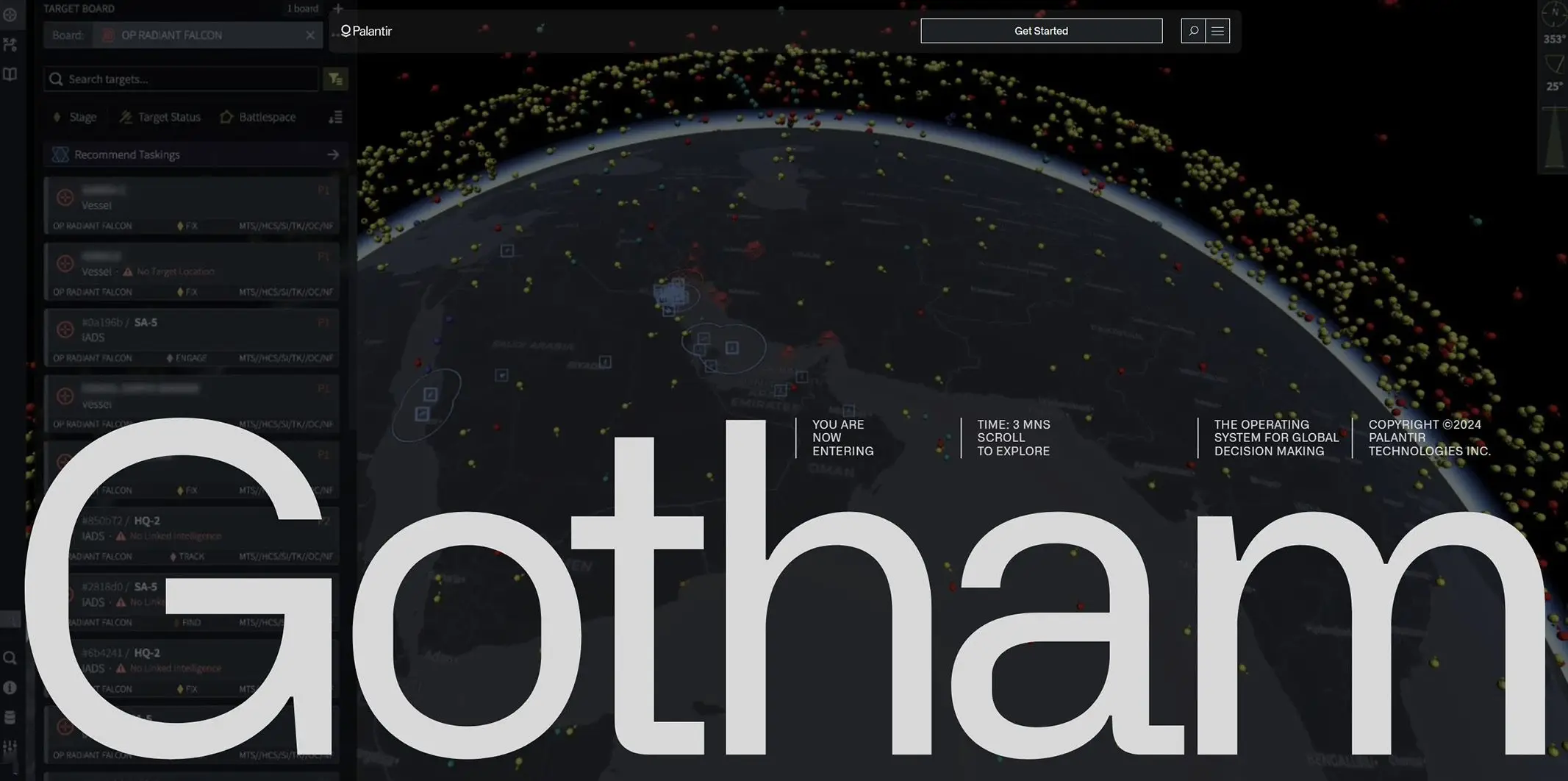
The Palantir Gotham platform, developed by Palantir Technologies, is an operational intelligence and data integration system designed for defense, intelligence, and law enforcement applications. Unlike a kinetic platform, Gotham is a software-defined operational environment that integrates, analyzes, and operationalizes large-scale heterogeneous data for mission decision-making.
It is best understood as a digital battlespace fusion layer—connecting disparate data sources, users, and workflows into a unified analytical framework.
1. Technology & Design
Gotham’s engineering philosophy centers on data fusion, access control, and operational usability under classified and multi-domain conditions. Rather than functioning as a traditional database, it operates as a layered data integration and analysis environment.
The system ingests structured and unstructured data from diverse sources including:
- Intelligence reports
- Signals intelligence (SIGINT)
- Geospatial data
- Biometric databases
- Operational logs
- Open-source intelligence (OSINT)
- Sensor feeds
A core technical differentiator is fine-grained data access control. Gotham enforces compartmentalization and classification boundaries at the object and attribute level, enabling multi-agency collaboration without full data exposure.
Architecture is typically deployed in secure on-premises environments, air-gapped networks, or accredited cloud infrastructures depending on mission classification. Its modular structure supports:
- Entity resolution
- Link analysis
- Geospatial visualization
- Temporal event sequencing
- Workflow automation
The platform includes ontology-driven data modeling, allowing organizations to define relationships between entities such as individuals, vehicles, communications nodes, or facilities.
Artificial intelligence and machine learning components assist in pattern detection, anomaly identification, and predictive analytics. However, Gotham is not a fully autonomous AI system; it is a human-in-the-loop intelligence augmentation tool.
Security is foundational. Encryption, identity-based access control, audit logging, and cross-domain integration safeguards are embedded at the architectural level.
Unlike single-purpose analytics tools, Gotham functions as a mission operating system for intelligence workflows rather than a standalone analysis module.
2. Role & Battlefield Function
Gotham operates at the operational and strategic levels of warfare and security operations.
Its primary role is intelligence fusion and decision support. It enables analysts and commanders to:
- Correlate disparate intelligence streams
- Identify networks and threat actors
- Track movements across geography and time
- Support targeting decisions
- Coordinate interagency operations
In military environments, Gotham can support counterterrorism, counterinsurgency, special operations, force protection, and strategic intelligence assessment.
At the tactical level, the platform assists in mission planning by providing integrated situational awareness. At the operational level, it supports theater-wide intelligence analysis. At the strategic level, it contributes to long-term threat modeling and policy-level decision support.
Integration with field units allows for near-real-time data updates, enhancing responsiveness. However, its effectiveness depends on network availability and secure data flows.
In law enforcement contexts, Gotham supports criminal network mapping and investigative coordination.
The battlefield environment is informational rather than kinetic—cyber, intelligence, and command domains.
3. Capabilities & Limitations
The primary capability of Gotham is large-scale data integration across silos. It reduces analytic friction by consolidating data into a single operational picture.
Its link analysis tools enable identification of hidden relationships between actors, organizations, and events. Geospatial mapping enhances operational clarity for field deployments.
Fine-grained access controls facilitate collaboration across agencies without violating classification protocols. This is a significant operational advantage in multinational or joint operations.
Scalability allows deployment from small investigative teams to national-level intelligence organizations.
Automation features reduce manual analytic workload, enabling analysts to focus on interpretation rather than data preparation.
However, limitations are structural and contextual.
First, data quality determines output quality. Incomplete, biased, or incorrect data can produce misleading analytic conclusions.
Second, the platform’s effectiveness depends heavily on proper configuration and ontology design. Poor data modeling reduces analytic value.
Third, integration with legacy systems can be complex and resource-intensive.
Fourth, privacy and civil liberties concerns arise in domestic deployments. Data aggregation at scale requires strict oversight and governance frameworks.
Fifth, the system does not replace human judgment. AI-assisted insights require validation and contextual interpretation.
Finally, cost and procurement complexity may limit adoption among smaller agencies.
4. Strategic Impact
Strategically, Gotham shifts intelligence operations from fragmented stovepipes to integrated digital ecosystems.
By accelerating information fusion, it shortens decision cycles and enhances operational tempo. Commanders gain faster access to actionable insights, which can influence outcomes in time-sensitive operations.
The platform reinforces data-driven warfare doctrine, where information dominance becomes as critical as kinetic capability.
In counterterrorism and counterinsurgency contexts, Gotham enables network-centric targeting—focusing on disrupting relationships rather than individual actors alone.
At the geopolitical level, widespread adoption of advanced data fusion systems contributes to a broader transformation of state power. Intelligence superiority increasingly derives from integration capacity rather than raw data collection alone.
However, centralization of sensitive data also creates cybersecurity and governance risks. Strategic resilience depends on secure infrastructure and disciplined oversight.
In long-term perspective, Palantir Gotham represents the institutionalization of digital intelligence infrastructure. It is not a weapon, aircraft, or vehicle—but it directly shapes how such assets are tasked and employed.
Its strategic significance lies in enabling coordinated, data-driven operations across military and security domains, redefining how information is operationalized in 21st-century conflict environments.





Comments are closed