
1. Technology & Design
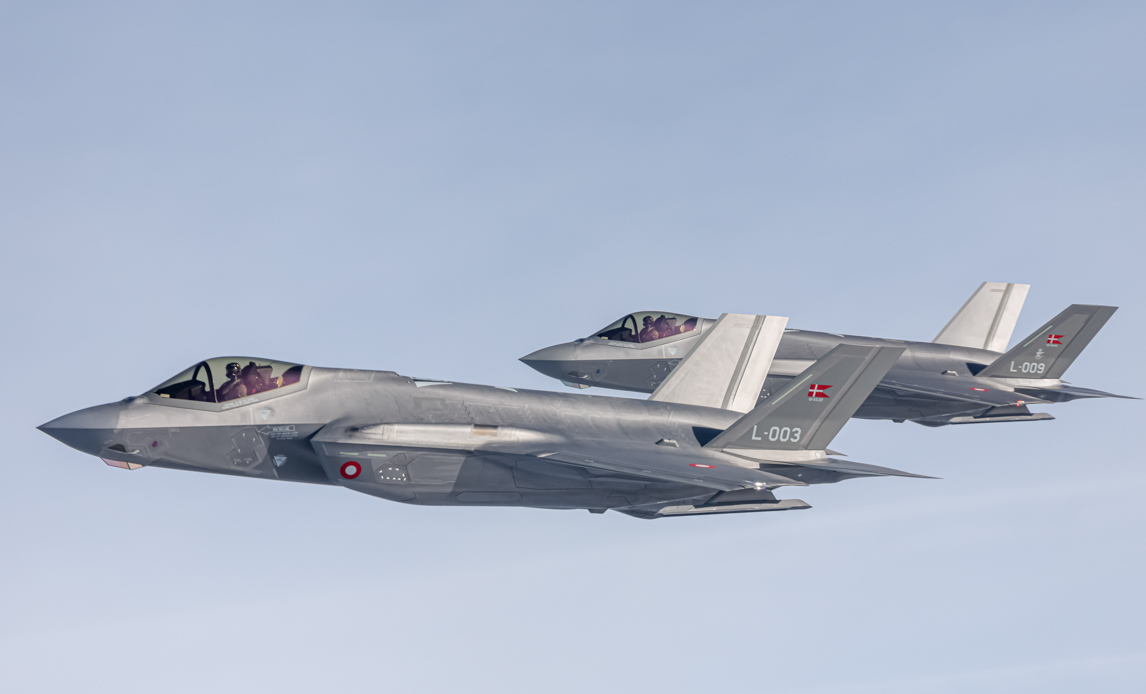
The F-35 Lightning II, developed by Lockheed Martin under the Joint Strike Fighter (JSF) program, is a fifth-generation multirole combat aircraft designed to replace a wide range of legacy platforms across U.S. and allied air forces.
The engineering philosophy centers on sensor fusion, low observable (LO) survivability, and multi-domain integration rather than pure kinematic superiority. Unlike airframes optimized primarily for speed or maneuverability, the F-35 is built around information dominance—detecting, classifying, and engaging threats before being detected itself.
Structurally, the F-35 uses advanced composite materials and radar-absorbent coatings to reduce radar cross-section (RCS). Its internal weapons bays preserve LO configuration during high-threat penetration missions. The fuselage employs blended shaping, edge alignment, and inlet treatments to minimize radar reflections from frontal and lateral aspects.
Three variants share a common design core:
- F-35A (conventional takeoff and landing, CTOL)
- F-35B (short takeoff/vertical landing, STOVL)
- F-35C (carrier variant with reinforced landing gear and larger wings)
Propulsion is provided by the Pratt & Whitney F135 turbofan engine, one of the most powerful fighter engines in service. In the F-35B, a shaft-driven lift fan system enables STOVL operations, introducing significant mechanical complexity but providing expeditionary flexibility.
Power generation capacity is unusually high for a fighter aircraft, supporting advanced avionics and electronic warfare systems. Electrical margin is a key design feature, enabling future upgrades including enhanced sensors and potential directed-energy integration.
The sensor suite is anchored by the AN/APG-81 active electronically scanned array (AESA) radar, complemented by the Electro-Optical Targeting System (EOTS), Distributed Aperture System (DAS), and advanced electronic warfare capabilities. The aircraft fuses these inputs into a single integrated tactical picture displayed on a panoramic cockpit touchscreen interface.
Networking is central to the platform. The Multifunction Advanced Data Link (MADL) allows secure communication between F-35s, while Link 16 integration connects the aircraft to broader joint and coalition networks.
Armament includes internal carriage of air-to-air and air-to-ground munitions such as AIM-120 AMRAAM, AIM-9X, JDAM, and Small Diameter Bombs. External hardpoints are available when stealth is not required, significantly increasing payload capacity.
Defensive systems rely on low observability, electronic attack, and situational awareness rather than heavy armor. Survivability is achieved by avoiding detection and disrupting adversary sensor networks.
2. Role & Battlefield Function
The F-35’s primary role is multirole strike and air dominance within contested environments. It operates at the tactical level while contributing to operational and strategic-level effects through networked integration.
Its core battlefield function is first-day-of-war penetration. In high-threat anti-access/area-denial (A2/AD) environments, the F-35 is tasked with:
- Suppression and destruction of enemy air defenses (SEAD/DEAD)
- High-value target strike
- Air superiority against advanced fighters
- ISR and battle management
Unlike legacy fighters optimized for singular missions, the F-35 is designed to perform strike, electronic warfare, ISR, and air combat simultaneously.
Within force structure, it serves as both shooter and sensor node. F-35 formations can detect and share targeting data with fourth-generation aircraft, naval vessels, and ground-based systems, acting as forward reconnaissance and targeting assets.
The F-35B variant enables short or vertical operations from amphibious assault ships, expanding naval aviation reach. The F-35C integrates into carrier air wings, enhancing fleet air defense and deep strike capability.
Deployment doctrine emphasizes coalition interoperability. Numerous NATO and Indo-Pacific partners operate the F-35, creating shared data architecture across allied forces.
The aircraft operates across air, maritime, and land environments, with increasing integration into joint all-domain command and control (JADC2) concepts.
3. Capabilities & Limitations
The F-35’s defining capability is sensor fusion. By integrating radar, infrared, electronic support measures, and offboard inputs into a coherent tactical picture, it reduces pilot cognitive load and accelerates decision cycles.
Low observability enhances survivability in dense air defense environments. Internal weapons carriage allows strike missions without significantly increasing radar signature.
Networking capabilities enable distributed kill chains. The F-35 can detect a target and cue another platform—airborne or surface-based—to engage, extending its impact beyond its own weapons load.
High electrical power capacity ensures upgrade potential over decades of service life.
However, limitations are evident.
First, acquisition and sustainment costs are significant, though unit costs have declined over production cycles. Lifecycle sustainment remains a major budget consideration for participating nations.
Second, stealth effectiveness is aspect-dependent. While highly survivable from frontal aspects, signature increases with external stores or from certain angles.
Third, the aircraft’s single-engine configuration introduces risk relative to twin-engine fighters in certain operational scenarios, though reliability metrics are high.
Fourth, maintenance complexity—particularly concerning low observable coatings and advanced avionics—demands robust logistics infrastructure.
Fifth, the aircraft’s multirole optimization means it does not dominate in pure kinematic dogfighting compared to specialized air superiority platforms, though sensor and missile advantages mitigate this limitation.
Finally, reliance on software architecture creates vulnerability to cyber threats and data-link disruption, requiring continuous cybersecurity investment.
4. Strategic Impact
Strategically, the F-35 reshapes airpower from platform-centric combat to network-centric warfare.
Its proliferation among allied nations creates interoperability at an unprecedented level. Shared data links and common mission systems enhance coalition cohesion and collective deterrence.
The aircraft strengthens deterrence by complicating adversary air defense planning. Its ability to penetrate defended airspace and strike high-value targets increases uncertainty for potential adversaries.
Doctrinally, the F-35 shifts emphasis from individual aircraft performance to integrated battle networks. It functions as both sensor and shooter, blurring the distinction between reconnaissance and strike assets.
Adversaries respond by investing in counter-stealth radar, long-range missiles, electronic warfare, and anti-access systems. Thus, the F-35 drives innovation cycles in both offensive and defensive technologies.
In long-term perspective, the F-35 represents a generational transformation in tactical aviation. It is less a traditional fighter and more a flying combat node—integrating sensing, strike, and command functions into a single platform.
Its strategic value lies not solely in air combat performance but in enabling information dominance across coalition forces in contested 21st-century battlespaces.


Comments are closed