
1. Technology & Design
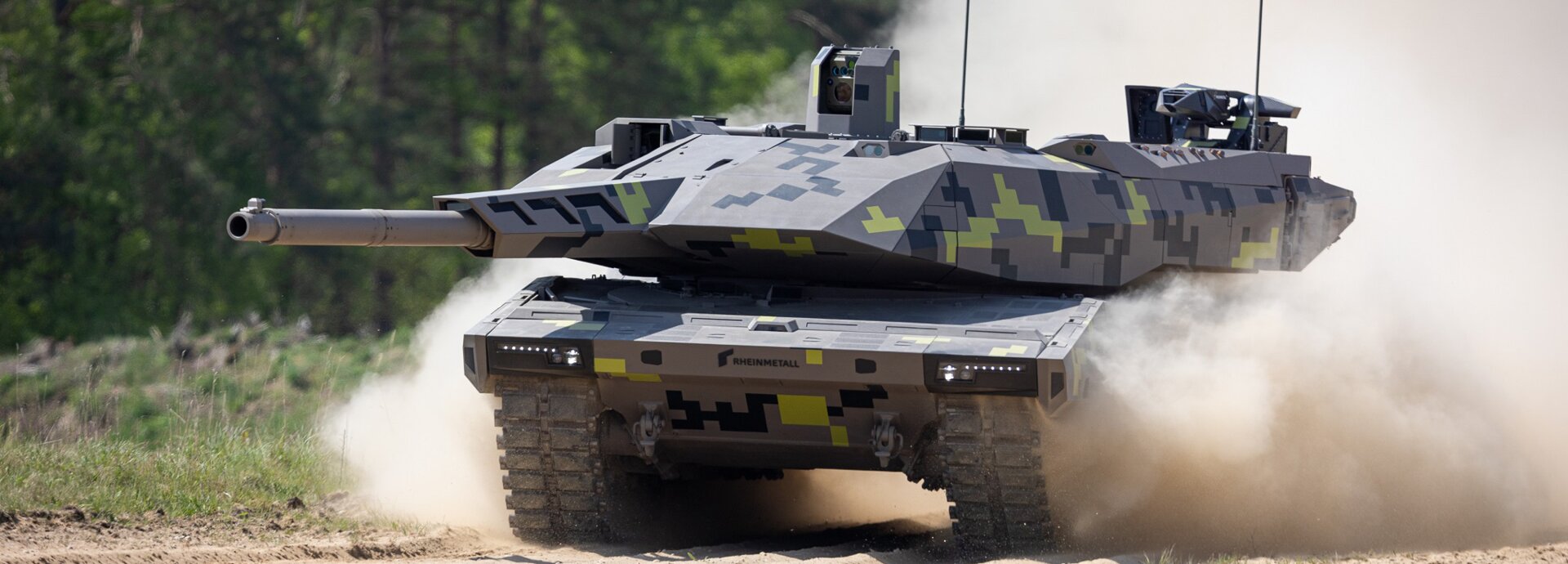
The KF51 Panther, developed by Rheinmetall, represents a next-generation main battle tank (MBT) concept aimed at restoring overmatch against evolving armored and anti-armor threats. Publicly unveiled in 2022, the KF51 is positioned as a rapid-development alternative to longer-cycle multinational programs, leveraging mature Leopard 2 chassis architecture while introducing substantial turret and firepower innovations.
The central technological differentiator is the Rheinmetall Future Gun System (FGS) 130 mm smoothbore cannon. This weapon is designed to deliver significantly greater muzzle energy than the legacy 120 mm L/55 systems fielded on contemporary Western MBTs. The larger caliber enables next-generation kinetic energy penetrators and programmable ammunition types, intended to defeat advanced composite and reactive armor systems.
The turret architecture is newly designed and digitally integrated. It incorporates an autoloading system, reducing crew requirements to three (commander, gunner, driver) while preserving optional fourth-crew integration for systems management or drone control. The autoloader enhances rate of fire consistency and allows larger ammunition dimensions incompatible with manual loading.
The hull reportedly leverages a Leopard 2-derived automotive base, ensuring logistical familiarity and mature mobility characteristics. Propulsion is expected to remain in the 1,500 horsepower class, maintaining high power-to-weight ratios for maneuver warfare. Exact engine configuration details remain limited in open sources.
Armor architecture combines passive composite protection with modular add-on armor packages. The KF51 integrates active protection systems (APS), including hard-kill interceptors designed to neutralize incoming anti-tank guided missiles (ATGMs) and rocket-propelled threats. Soft-kill systems, including multispectral smoke and electronic countermeasures, complement kinetic defenses.
Sensor integration is extensive. The platform incorporates panoramic commander sights, advanced thermal imaging, laser warning receivers, and battlefield networking interfaces. Rheinmetall emphasizes digital backbone architecture, allowing integration into networked combined-arms environments.
Secondary armament includes a coaxial machine gun, a remotely operated weapon station (RWS), and the optional integration of loitering munitions launched directly from the turret. This indicates a shift toward multi-domain lethality at the platform level.
2. Role & Battlefield Function
The KF51 Panther is designed as a front-line breakthrough and armored superiority platform operating at the tactical level within high-intensity peer conflict scenarios.
Its primary mission is overmatch against next-generation MBTs and fortified positions. The 130 mm main gun reflects anticipation of heavily protected adversary platforms, particularly those incorporating advanced reactive armor and active protection systems.
Secondary roles include:
- Urban and semi-urban armored maneuver
- Defensive counterattack operations
- Integration with mechanized infantry formations
- Stand-off engagement using loitering munitions
Within force structure, the Panther operates as the spearhead of armored brigades. Its digital systems enable integration with reconnaissance drones, artillery networks, and infantry fighting vehicles.
Deployment doctrine aligns with maneuver warfare principles. High mobility combined with enhanced lethality allows rapid exploitation of breakthroughs. The integration of APS indicates preparation for saturated ATGM environments characteristic of modern battlefields.
The platform is optimized for land warfare in contested environments featuring dense anti-armor threat proliferation, including drones, top-attack munitions, and long-range guided weapons.
3. Capabilities & Limitations
The most significant capability enhancement lies in firepower. The 130 mm cannon delivers increased kinetic energy, theoretically restoring penetration superiority against heavily armored adversaries. Programmable airburst and advanced munitions expand mission flexibility.
Autoloading increases efficiency and reduces crew size, lowering long-term manpower requirements while allowing larger ammunition.
Active protection systems improve survivability against the proliferation of ATGMs and loitering munitions. Combined with modular armor, the Panther is designed for layered defense rather than passive armor mass alone.
Digital architecture enhances interoperability. Integrated sensors and networking facilitate faster target acquisition and data sharing.
Mobility remains competitive with existing Western MBTs, preserving operational tempo.
However, limitations must be acknowledged.
First, the KF51 remains a demonstrator-stage or early development platform rather than a fully fielded operational system. Production scalability, reliability data, and lifecycle cost remain uncertain.
Second, the introduction of a new 130 mm ammunition standard creates logistical complexity. Existing NATO ammunition stocks are based on 120 mm systems, requiring new supply chains and industrial scaling.
Third, weight growth from enhanced protection and systems integration may challenge mobility in certain terrain or infrastructure environments.
Fourth, autoloaders introduce mechanical complexity. While reducing crew size, they require high reliability under combat stress.
Fifth, survivability against top-attack drones and advanced loitering munitions remains a dynamic challenge. APS effectiveness against multi-angle swarm threats is still an evolving domain.
Finally, acquisition cost is likely high relative to upgraded Leopard 2 variants, potentially limiting rapid adoption.
4. Strategic Impact
Strategically, the KF51 Panther signals a renewed emphasis on heavy armor in European defense planning.
Following years of counterinsurgency focus, the return of large-scale mechanized warfare in Europe has revalidated the importance of armored breakthrough capability. The Panther represents an attempt to leap ahead of incremental upgrades and establish a new benchmark in tank lethality.
Its development also reflects industrial competition within Europe. By independently advancing a next-generation concept, Rheinmetall positions itself strategically within ongoing debates surrounding the Franco-German Main Ground Combat System (MGCS) program.
Doctrinally, the Panther supports a shift toward digitally integrated, highly lethal armored formations operating in contested electronic and drone-saturated environments.
The introduction of a 130 mm main gun may trigger competitive responses from other armored vehicle manufacturers, potentially reshaping NATO ammunition standards and interoperability frameworks.
In long-term perspective, the KF51 Panther represents an evolutionary rather than revolutionary platform. It preserves the core MBT concept—mobility, protection, firepower—while modernizing each pillar to address emerging threats.
Its ultimate strategic significance will depend on adoption scale, cost control, and integration into broader European armored modernization programs. If fielded widely, it could redefine Western armored overmatch standards for the coming decades.


Comments are closed