

Note: As of publicly available information through 2026, there is no formally designated U.S. defense program titled “Golden Dome for America.” The term has been used in political and conceptual discussions to describe a nationwide, layered missile defense architecture. The following assessment analyzes such a concept from a technical and strategic standpoint, referencing known U.S. missile defense systems and industry capabilities.
1. Technology & Design
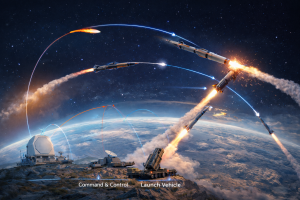
A “Golden Dome for America” concept would represent a fully integrated, multi-layered homeland missile defense shield designed to counter ballistic, cruise, hypersonic, and potentially orbital threats. If led or significantly supported by Lockheed Martin, the architecture would likely build upon existing U.S. missile defense systems rather than constitute a single monolithic platform.
The engineering philosophy would emphasize layered interception, persistent sensing, and network-centric battle management. Rather than relying on a singular defensive barrier, the architecture would integrate space-based sensors, ground-based interceptors, sea-based systems, and potentially airborne components into a unified command-and-control framework.
Core structural components would likely include:
- Ground-Based Midcourse Defense (GMD) interceptors for intercontinental ballistic missile (ICBM) threats
- THAAD batteries for terminal-phase ballistic missile defense
- Aegis Combat System equipped destroyers and cruisers with SM-3/SM-6 interceptors
- Advanced radar systems such as AN/TPY-2 and long-range discrimination radars
- Space-based infrared (SBIR) and next-generation overhead persistent infrared (OPIR) sensors
The “dome” characterization implies comprehensive geographic coverage, similar in concept—but not scale—to Iron Dome. However, unlike Iron Dome’s short-range focus, a U.S. homeland architecture must address threats spanning thousands of kilometers, including hypersonic glide vehicles.
Power generation and sustainment would rely on distributed terrestrial infrastructure rather than a centralized power core. Data fusion would be handled through secure digital battle management systems, potentially leveraging AI-assisted threat discrimination to distinguish warheads from decoys during midcourse phases.
AI integration would be critical. Hypersonic and maneuvering threats compress decision timelines, necessitating automated tracking, intercept calculation, and fire control solutions. However, lethal authorization would likely remain under human command authority.
Defensive mechanisms would include kinetic interceptors (hit-to-kill), potentially directed-energy research pathways, and electronic warfare integration for cruise missile disruption.
The technological distinctiveness of such an architecture would lie not in any single interceptor but in real-time sensor fusion and cross-domain integration at continental scale.
2. Role & Battlefield Function
The primary role of a “Golden Dome” architecture would be strategic homeland defense. It would operate at the strategic level of warfare, focused on national survival and deterrence preservation rather than tactical battlefield support.
Its mission set would include:
- Defense against limited ICBM attacks
- Protection against rogue-state missile threats
- Defense against hypersonic glide vehicles
- Interception of long-range cruise missile incursions
- Protection of critical infrastructure nodes
Within force hierarchy, the system would sit under U.S. Northern Command (USNORTHCOM) and integrate with the Missile Defense Agency (MDA), Air Force Global Strike Command, and naval components.
Deployment doctrine would emphasize persistent readiness rather than expeditionary maneuver. Sea-based Aegis ships would provide mobile layers, while ground-based interceptors in Alaska and California would serve as primary midcourse defense nodes.
In practice, commanders would employ a shoot-look-shoot doctrine—launching interceptors, assessing success, and engaging again if necessary.
The architecture’s operational environment spans space, exo-atmospheric midcourse, high-altitude terminal phases, and low-altitude cruise missile trajectories. It is inherently multi-domain.
3. Capabilities & Limitations
The primary capability of a nationwide layered missile defense system is deterrence reinforcement. Even partial interception capability complicates adversary attack planning and reduces confidence in strike success.
Layered defense increases probability of intercept by providing multiple engagement opportunities. Space-based sensors improve early detection, extending reaction time.
Integration with naval Aegis systems enhances flexibility. Sea-based assets can reposition to cover emerging threat vectors.
AI-assisted discrimination enhances midcourse effectiveness, especially against decoys and complex penetration aids.
However, limitations are structural and strategic.
First, scale challenges are immense. The geographic size of the United States requires wide-area coverage against threats from multiple azimuths.
Second, missile defense saturation remains a core vulnerability. Large-scale peer adversary arsenals could overwhelm interceptor inventories.
Third, hypersonic glide vehicles reduce engagement windows and complicate tracking due to maneuverability and depressed trajectories.
Fourth, cost exchange ratios favor the attacker. Interceptors are expensive; offensive missiles can be produced at scale more cheaply.
Fifth, strategic stability concerns arise. Large-scale missile defense architectures may incentivize adversaries to expand offensive arsenals to preserve deterrent credibility.
Finally, complete protection is technically unrealistic. Missile defense reduces risk but cannot guarantee total interception, especially against large-scale nuclear exchange scenarios.
4. Strategic Impact
Strategically, a “Golden Dome” architecture would signal commitment to active homeland defense rather than exclusive reliance on nuclear deterrence through retaliation.
It would strengthen deterrence against limited or rogue-state missile threats by reducing confidence in successful coercive strikes.
However, against peer nuclear powers, its effect is more complex. Large-scale missile defense expansion could:
- Encourage quantitative or qualitative offensive missile expansion
- Accelerate hypersonic and decoy development
- Complicate arms control frameworks
Doctrinally, the system reflects a shift toward integrated, persistent defense in an era of proliferating missile technologies.
Allied implications are significant. Expanded U.S. homeland defense may influence extended deterrence credibility and NATO missile defense integration.
Long-term, such an architecture would not eliminate strategic vulnerability but would alter risk calculations. Its greatest value lies in reducing exposure to limited attacks, accidental launches, or coercive missile threats.
In realistic strategic terms, a “Golden Dome for America” would not be an impenetrable shield. It would be a layered, probabilistic defense network—designed to buy decision time, reduce damage, and reinforce deterrence in an increasingly complex missile threat environment.
Its effectiveness would depend less on a single breakthrough technology and more on sustained investment in integration, sensor fidelity, interceptor reliability, and resilient command-and-control architecture.




Comments are closed