
1. Technology & Design
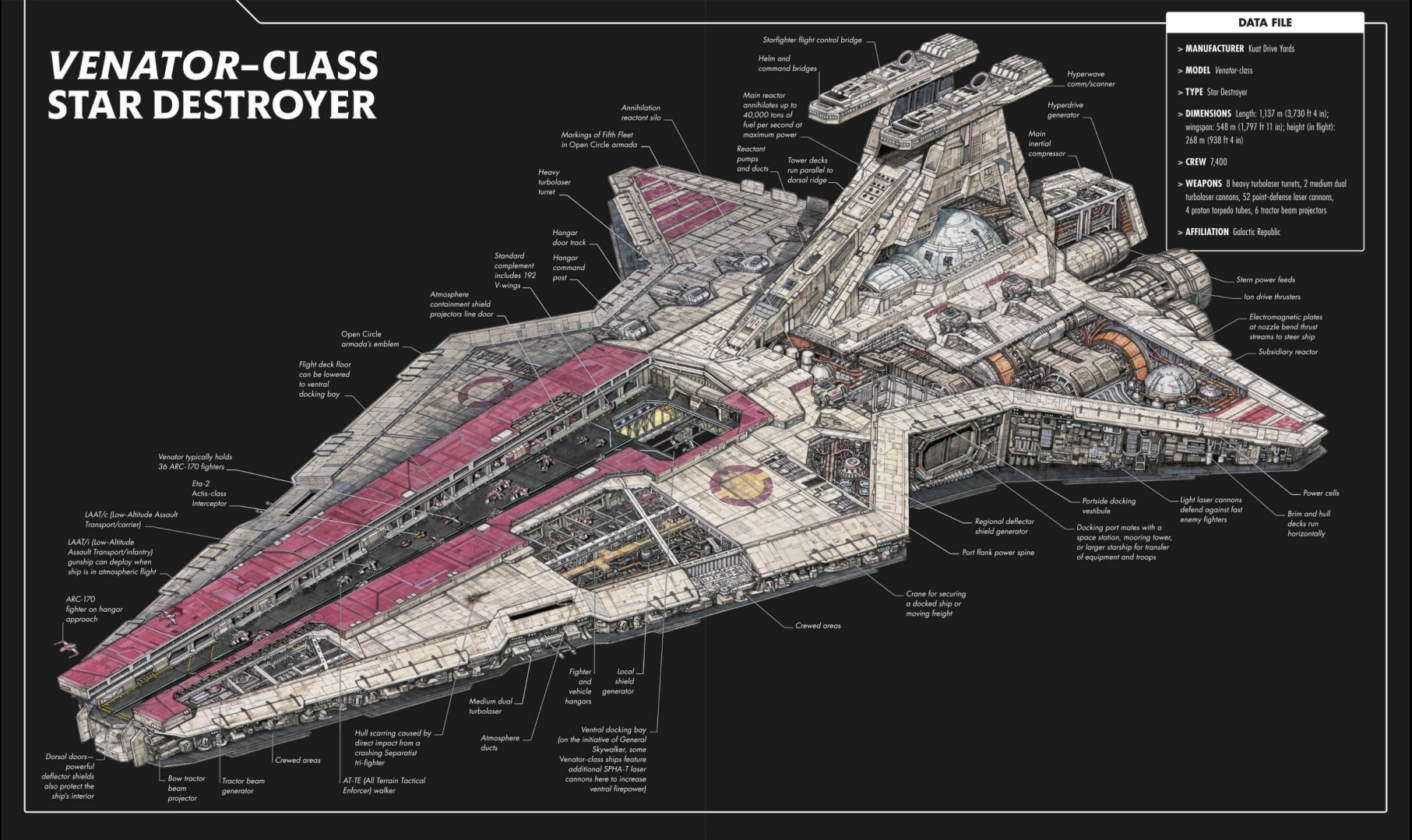
The Venator-class Star Destroyer represents a transitional capital ship architecture developed for the Galactic Republic during the Clone Wars. Manufactured primarily by Kuat Drive Yards, the platform merges fleet carrier functionality with heavy capital-ship firepower, reflecting a doctrine that prioritizes starfighter dominance while retaining ship-to-ship lethality.
Structurally, the Venator adopts the wedge-shaped hull geometry that would later define Imperial Star Destroyer designs. The dorsal flight deck is integrated along the vessel’s centerline, featuring large armored blast doors that open to expose an expansive internal hangar complex. Unlike later Imperial designs that emphasize intimidation and heavy axial firepower, the Venator’s internal volume allocation favors aviation facilities: maintenance bays, launch racks, and rapid sortie handling infrastructure.
At approximately 1,137 meters in length (canon figures vary slightly between continuities), the ship occupies an intermediate class between heavy cruiser and fleet carrier. Its internal compartmentalization supports both naval and ground operations, including clone troop contingents and armored vehicles for planetary assault missions.
Propulsion is provided by a primary sublight engine cluster supplemented by maneuvering thrusters distributed along the hull. The vessel is equipped with a Class 1 hyperdrive (in most canon references), enabling strategic redeployment across the Galactic Republic. Redundant hyperdrive backups increase survivability in extended campaigns.
Power generation derives from a central reactor core, feeding energy to propulsion, weapons systems, deflector shields, and hangar operations. While specific reactor type is not consistently detailed in canon sources, the scale of shield projection and heavy turbolaser output indicates high-density energy production consistent with other capital ships of the era.
Armament reflects hybrid doctrine. The Venator mounts:
- Heavy dual turbolaser turrets along the dorsal hull for capital ship engagements
- Medium turbolasers and point-defense cannons
- Proton torpedo launchers
- Extensive anti-starfighter batteries
Unlike later Imperial Star Destroyers, its weapons are not optimized solely for line-of-battle dominance; they are balanced to protect carrier operations.
Sensor arrays are integrated into the command tower structure, providing long-range detection, target tracking, and fleet coordination. Communications systems enable command-and-control over large starfighter wings and task forces, making the ship suitable as a sector-level command node.
Defensive systems include multi-layered deflector shielding, reinforced hull plating, and internal compartmentalization to mitigate catastrophic decompression. However, the large dorsal flight deck creates a structural vulnerability during active launch cycles.
2. Role & Battlefield Function
The Venator’s primary mission role is fleet carrier and line combatant within Republic naval doctrine. It operates at the operational level of warfare, commanding battlegroups and projecting both space and planetary force.
Its defining battlefield function is starfighter deployment. A single Venator can deploy hundreds of fighters and bombers, including ARC-170s, V-19 Torrents, and later V-wings, depending on campaign phase. This emphasis reflects the Republic’s reliance on clone pilots and massed fighter operations to counter Separatist droid fleets.
Secondary roles include:
- Orbital fire support for planetary invasions
- Troop transport and rapid planetary assault staging
- Sector command and fleet coordination
- Convoy escort during strategic redeployment
Within a task force, the Venator typically operates alongside Acclamator-class assault ships and escort frigates. It bridges the gap between dedicated assault transports and heavy battleships, enabling simultaneous space superiority and planetary insertion operations.
Deployment doctrine prioritizes aerospace control. Venators launch fighters early in engagement sequences, attempting to establish dominance before committing to sustained capital-ship exchanges. This approach contrasts with later Imperial doctrine, which emphasized direct heavy ship engagements supported by fewer starfighters.
The ship is effective in deep-space fleet combat, orbital blockade, and planetary assault scenarios. However, it is less suited for independent patrol duties in low-intensity theaters due to its size and logistical footprint.
3. Capabilities & Limitations
The Venator’s primary capability lies in force projection through carrier-based aerospace power. Its fighter capacity provides:
- Wide-area interception coverage
- Precision strike capability
- Anti-capital ship bombing potential
- Reconnaissance reach beyond sensor horizon
Its hyperdrive speed allows rapid theater shifts, giving the Republic operational flexibility across multiple fronts of the Clone Wars.
Heavy turbolasers grant it credible capital-ship lethality. While not matching later Imperial-class destroyers in raw firepower, the Venator remains capable of engaging Separatist cruisers and battleships directly.
Operational flexibility is high. It can transition between fleet command, planetary support, and sustained patrol operations with minimal reconfiguration.
However, limitations are significant.
First, the dorsal flight deck presents structural vulnerability. When hangar doors are open for mass launch operations, shield coverage can be stressed, and the internal hangar becomes a critical weak point. Historical engagements in both canon and Legends demonstrate that internal reactor or hangar strikes can cause catastrophic failure.
Second, its hybrid design creates compromise. It is neither a pure carrier nor a dedicated battleship. In direct engagements against heavily armored warships optimized for broadside exchanges, the Venator may be outmatched.
Third, its crew and logistical requirements are substantial. Operating large fighter complements requires maintenance crews, munitions storage, and spare parts infrastructure. Sustained campaigns demand secure supply lines.
Fourth, command tower prominence creates a high-value target. Bridge destruction can impair fleet coordination.
Cost and production scale were significant during the Clone Wars. While produced in large numbers relative to later Imperial capital ships, each vessel represented considerable industrial investment from the Republic.
4. Strategic Impact
Strategically, the Venator enabled the Republic to wage a galaxy-wide industrial war. Its combination of mobility, fighter capacity, and capital-ship firepower allowed the Republic Navy to respond to distributed Separatist threats.
The ship reinforced a doctrine centered on aerospace superiority rather than pure battleship engagement. By prioritizing fighters, the Republic leveraged clone pilot effectiveness against largely automated droid fleets. This shaped Clone Wars naval combat toward combined-arms fleet operations rather than singular capital-ship duels.
The Venator also served as a transitional architecture. Its wedge hull and command tower design directly influenced the later Imperial Star Destroyer lineage. However, Imperial doctrine shifted emphasis from carrier-centric warfare to psychological dominance and heavy ship-based suppression, reducing fighter proportion in favor of centralized authority projection.
In terms of deterrence, a Venator task force symbolized Republic reach. Its arrival in orbit indicated imminent aerospace control and potential planetary intervention.
Escalation dynamics were also influenced. Because the ship could conduct both blockade and invasion support, its deployment often signaled preparation for decisive action rather than limited patrol.
In long-term doctrinal evolution, the Venator marks the peak of Republic-era carrier integration within capital ships. It demonstrates an understanding that control of space is achieved not solely by larger guns, but by distributed strike capability and aerospace reach.
Within the Star Wars strategic framework, the Venator was not merely a warship. It was the Republic’s instrument for maintaining cohesion across a fragmented galaxy—combining mobility, airpower, and command authority into a single deployable capital platform.



Comments are closed