
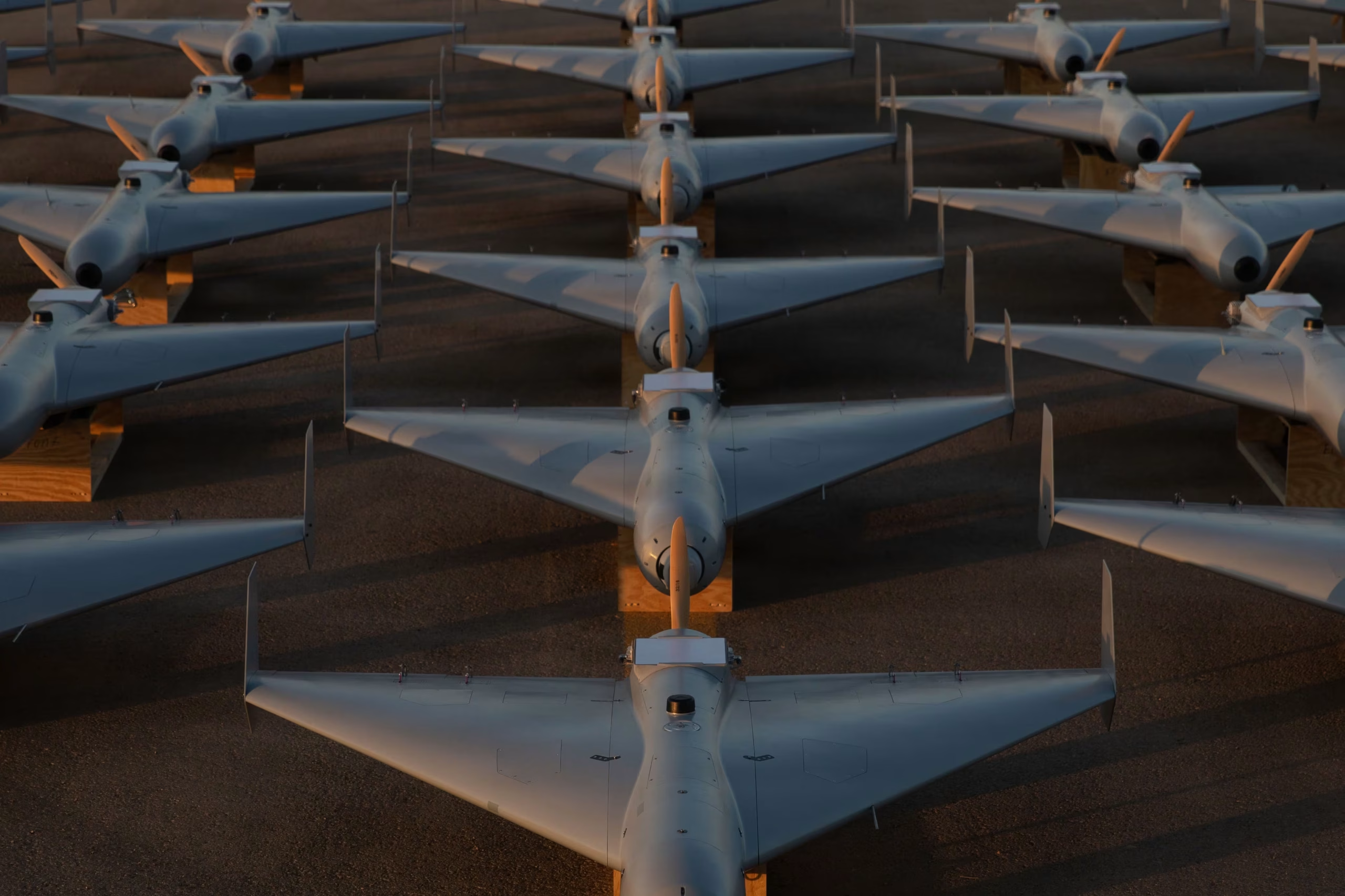
The LUCAS (Low-Cost Uncrewed Combat Attack System) is a U.S.-developed one-way attack drone concept designed to provide scalable, attritable strike capability against high-value targets. Publicly presented as a low-cost alternative to larger long-range strike drones, LUCAS reflects the growing emphasis on mass-produced loitering munitions in modern conflict environments.
It belongs to the broader category of one-way attack systems (OWA-UAS), sometimes referred to as loitering munitions or “kamikaze drones,” designed to loiter in an area before striking a designated target.
1. Technology & Design
The LUCAS concept prioritizes affordability, modularity, and rapid production scalability. Its engineering philosophy centers on cost-effective strike mass rather than exquisite survivability.
Structurally, LUCAS features a fixed-wing configuration optimized for long-endurance flight and efficient cruise performance. The design suggests lightweight composite construction to minimize production costs while maintaining aerodynamic efficiency.
Propulsion is typically provided by a small piston or turbine engine (exact specifications vary by configuration), offering extended range and loiter time. This allows the drone to travel significant distances before entering a loitering pattern over the target area.
The warhead payload is modular. Depending on mission profile, LUCAS can carry high-explosive fragmentation, anti-armor, or specialized payloads designed to target infrastructure or radar systems.
Guidance architecture integrates:
- GPS-based navigation
- Inertial navigation systems (INS)
- Electro-optical targeting sensors
- Secure data links for remote operator input
In some configurations, terminal guidance may include AI-assisted target recognition, enabling semi-autonomous strike execution.
Launch systems are designed for mobility and simplicity, including truck-mounted rails or containerized launch modules. This enables distributed deployment from austere locations.
Unlike larger unmanned combat aerial vehicles (UCAVs), LUCAS is not designed for recovery. It is expended upon impact, reducing design complexity and maintenance burden.
Defensive systems are minimal. Survivability relies on low cost, low radar cross-section due to size, and massed employment rather than armor or advanced countermeasures.
2. Role & Battlefield Function
LUCAS operates at the tactical and operational levels as a precision strike and suppression asset.
Its primary role is stand-off attack against:
- Air defense systems
- Radar installations
- Artillery positions
- Command nodes
- Logistics hubs
In a peer conflict environment, LUCAS can function as a first-wave suppression tool, saturating air defenses and forcing adversaries to expend interceptor resources.
Secondary roles include:
- Battlefield interdiction
- Counter-battery operations
- Maritime strike against small vessels
- ISR-to-strike transition missions
Deployment doctrine emphasizes distributed launch and swarm employment. By launching multiple drones simultaneously from dispersed locations, operators increase the probability of successful penetration.
The system is particularly suited to contested environments where traditional crewed aircraft face elevated risk.
LUCAS operates across land and maritime domains and may be used in conjunction with larger missile systems to create layered offensive effects.
3. Capabilities & Limitations
The primary capability of LUCAS is cost-efficient strike mass. Compared to cruise missiles, one-way drones are typically less expensive, enabling greater numerical deployment.
Extended loiter time enhances flexibility. Operators can redirect or delay strike until optimal targeting conditions are met.
Distributed launch architecture reduces vulnerability to preemptive strikes on centralized airbases.
Low radar signature relative to size complicates detection, particularly at low altitudes.
However, limitations are significant.
First, survivability against advanced integrated air defense systems (IADS) is limited. Modern radar and layered defenses can detect and intercept such drones if sufficient coverage exists.
Second, electronic warfare (EW) presents a vulnerability. GPS jamming or data link disruption can degrade navigation and targeting accuracy.
Third, payload size is constrained by airframe scale. LUCAS cannot match the destructive capacity of larger cruise missiles or ballistic weapons.
Fourth, single-use design eliminates recovery and reuse, requiring sustained production to maintain inventory.
Fifth, effectiveness depends heavily on intelligence accuracy. Incorrect targeting data reduces mission value.
Finally, saturation tactics require careful coordination. Swarm mismanagement can lead to fratricide or inefficient target allocation.
4. Strategic Impact
Strategically, systems like LUCAS represent a shift toward democratized precision strike capability. The barrier to entry for long-range precision attack is lowered compared to traditional missile systems.
In peer conflict, large inventories of low-cost one-way drones can stress high-end air defense systems by forcing adversaries to use expensive interceptors against inexpensive attackers.
This alters cost-exchange ratios and incentivizes defensive innovation in directed energy, electronic warfare, and automated interception systems.
Doctrinally, LUCAS supports distributed lethality and massed attrition strategies. Instead of relying solely on limited high-end platforms, commanders can employ waves of expendable assets to degrade defenses before committing higher-value systems.
In asymmetric conflicts, one-way drones provide non-state actors and smaller states with disproportionate strike reach, increasing instability in contested regions.
However, proliferation risk is significant. As production costs decline, similar systems may spread across global markets, reducing technological exclusivity.
In long-term perspective, LUCAS and comparable systems represent an evolution in strike warfare: shifting from platform-centric dominance to scalable, attritable, networked attack ecosystems.
Its strategic significance lies not in individual lethality, but in cumulative effect—reshaping air defense economics and operational planning in modern conflict environments.


Comments are closed