
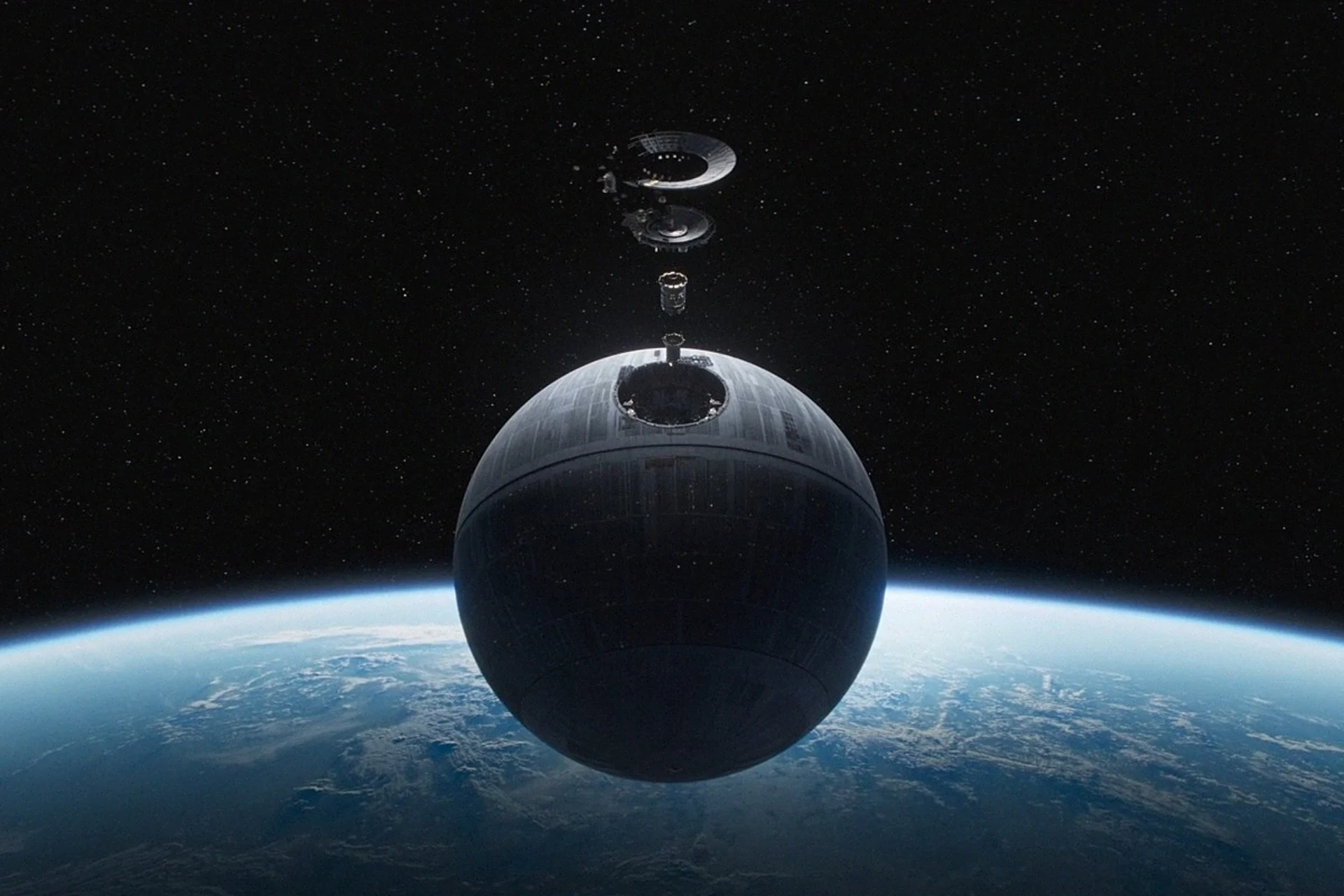
The Death Star is a moon-sized mobile battle station developed by the Galactic Empire as a strategic superweapon within the Star Wars universe. Conceived as the ultimate instrument of coercion and deterrence, it integrates planetary-scale firepower, fleet command capability, and autonomous logistical infrastructure into a single platform.
It represents not merely a capital ship, but a centralized system of overwhelming destructive capacity designed to enforce political control through existential threat.
1. Technology & Design
The Death Star’s defining technological feature is its axial superlaser, capable of destroying an entire planet. The superlaser operates through a multi-stage energy focusing system, channeling massive reactor output into a coherent destructive beam. Canon sources describe kyber crystal–based focusing mechanisms in later interpretations, implying energy amplification via exotic crystalline matrices.
Structurally, the station is spherical, with a diameter of approximately 120 kilometers (first Death Star configuration). The spherical geometry distributes structural stress evenly and enables internal volumetric efficiency. Internally, the station contains:
- Reactor cores
- Command and control centers
- TIE fighter hangars
- Troop barracks
- Manufacturing and detention facilities
- Shield generators
- Hyperdrive systems
The internal reactor system must produce extraordinary energy output to power the superlaser. Energy storage and staged discharge systems are implied, as planetary destruction requires power levels far exceeding conventional capital ship weapons.
Propulsion includes large-scale sublight engines and a hyperdrive system, enabling interstellar movement. Although not maneuverable in a tactical sense, the Death Star can reposition strategically between star systems.
Defensive systems are layered:
- A powerful planetary shield (in the second Death Star configuration)
- Thousands of turbolaser batteries
- Heavy ion cannons
- Extensive TIE fighter complement
Sensor systems allow system-wide monitoring and targeting. As a command platform, it integrates fleet-level communications and battle coordination.
Technologically, the Death Star represents the extreme end of centralized military engineering: maximal firepower concentration within a singular hardened structure.
2. Role & Battlefield Function
The Death Star’s primary role is strategic deterrence through annihilation capability. It is not designed for tactical engagements or fleet skirmishes, although it can defend itself against conventional attack.
Its core function is political coercion. By demonstrating the ability to destroy entire planets, it transforms rebellion suppression from occupation-based enforcement to existential threat management.
Operationally, it functions at the strategic level of warfare. Commanders deploy it not to fight fleets but to enforce compliance across star systems.
Secondary roles include:
- Fleet command center
- Orbital blockade platform
- Military-industrial hub
- Psychological warfare instrument
Within Imperial doctrine, it represents the Tarkin Doctrine’s emphasis on rule through fear. Rather than relying on distributed naval presence, the Empire concentrates authority and destructive capability into a single symbol of dominance.
The battlefield environment is interstellar. The station moves between systems, positioning itself within range of planetary targets.
3. Capabilities & Limitations
The Death Star’s primary capability is unmatched destructive power. The ability to eliminate a planetary body renders conventional defense irrelevant. No planetary shield or fleet formation can withstand direct superlaser engagement.
Its defensive armament makes it formidable against conventional fleets. Thousands of turbolasers provide overlapping fire coverage.
The TIE fighter complement enhances point defense and interception capability.
Strategically, its mere presence compels political submission from vulnerable systems.
However, limitations are profound.
First, it concentrates enormous resources into a single asset. Construction requires planetary-scale industrial output, massive labor forces, and extended build timelines.
Second, despite its scale, it possesses critical vulnerabilities. The first Death Star contained a thermal exhaust port leading directly to the reactor core—an engineering flaw exploitable under specific conditions.
Third, maneuverability is limited. It cannot evade concentrated fleet assaults easily, relying instead on shields and defensive firepower.
Fourth, deployment is slow relative to smaller warships. Strategic repositioning requires time, limiting rapid-response flexibility.
Fifth, its reliance on intimidation may foster resistance rather than compliance. Destruction of a major world can radicalize opposition rather than eliminate it.
Finally, catastrophic loss results in enormous political and military consequences due to resource concentration and symbolic weight.
4. Strategic Impact
Strategically, the Death Star attempts to redefine deterrence. It replaces mutually assured destruction between peer powers with unilateral annihilation capability wielded by a centralized regime.
Its existence shifts power from distributed fleet control to singular superweapon dominance. However, this centralization undermines strategic resilience.
The destruction of the first Death Star demonstrates the inherent instability of over-centralized deterrence. When a regime ties its authority to a single superweapon, that weapon becomes a decisive vulnerability.
Doctrinally, the Death Star embodies maximum coercive escalation. Rather than scaling force proportionally, it introduces binary outcomes: compliance or destruction.
In real-world strategic parallels, the Death Star resembles a hyper-centralized nuclear deterrent combined with a mobile launch platform. However, unlike distributed nuclear arsenals, it lacks redundancy.
Long-term, its impact is paradoxical. While designed to cement Imperial dominance, it accelerates organized rebellion and exposes structural weaknesses in Imperial strategic planning.
The Death Star is therefore best understood as a political weapon more than a military one. Its battlefield performance is secondary to its symbolic role.
In strategic analysis, it represents the dangers of concentrating overwhelming power into a single, high-value system—capable of unprecedented destruction, yet structurally vulnerable to asymmetric exploitation.



Comments are closed