
1. Technology & Design
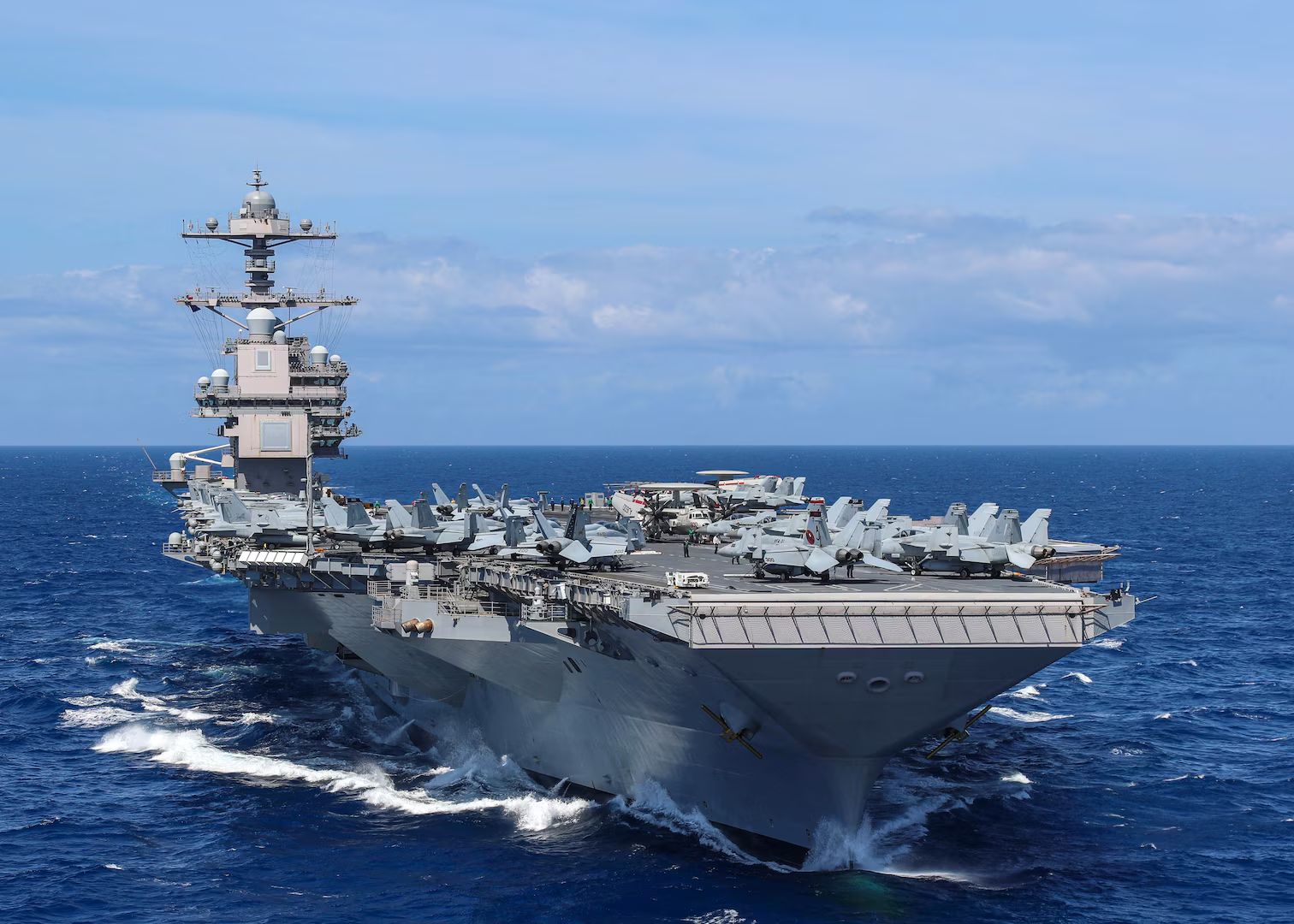
The USS Gerald R. Ford is the lead ship of the U.S. Navy’s Ford-class aircraft carriers and represents the most significant generational redesign of American carrier architecture since the Nimitz class. Built by Huntington Ingalls Industries at Newport News Shipbuilding, the vessel reflects a design philosophy centered on sortie generation rate, reduced lifecycle cost, increased electrical power margin, and long-term adaptability for future air wings and directed-energy systems.
At approximately 100,000 tons full load displacement and over 330 meters in length, the Ford retains the large-deck nuclear carrier configuration but incorporates substantial internal reengineering. One of the most visible structural changes is the repositioned and reduced island superstructure. By moving the island aft and optimizing deck layout, designers increased usable flight deck space and improved aircraft flow, directly supporting higher sortie rates.
Propulsion is provided by two Bechtel A1B nuclear reactors, replacing the A4W reactors used in Nimitz-class carriers. The A1B reactors generate significantly greater electrical output, supporting not only propulsion but also high-demand systems such as advanced radar arrays, electromagnetic launch systems, and future high-energy weapons. The expanded electrical margin is a central feature of the class, enabling long-term modernization without major structural redesign.
The most transformative technological change is the Electromagnetic Aircraft Launch System (EMALS), replacing traditional steam catapults. EMALS uses linear electromagnetic acceleration to launch aircraft with smoother force application, reduced airframe stress, and adjustable launch profiles tailored to aircraft weight. This improves compatibility with lighter unmanned systems and reduces maintenance demands associated with steam systems.
Complementing EMALS is the Advanced Arresting Gear (AAG), designed to accommodate a broader range of aircraft weights, including UAVs and next-generation strike platforms. Together, EMALS and AAG represent a systemic modernization of the launch and recovery cycle.
The ship’s sensor suite is anchored by the Dual Band Radar (DBR) concept, integrating X-band and S-band radar functions for air search, tracking, and fire control. While later ships in the class transitioned to the Enterprise Air Surveillance Radar (EASR) due to cost and integration considerations, the Ford reflects the Navy’s broader shift toward integrated digital sensor architectures.
Armament is defensive and layered. The carrier carries RIM-162 Evolved Sea Sparrow Missiles (ESSM), Rolling Airframe Missiles (RAM), Phalanx CIWS systems, and electronic warfare capabilities. It is not designed to engage in independent surface combat but relies on its carrier strike group (CSG) for layered defense including Aegis-equipped destroyers and cruisers.
Automation and digitalization are extensive. Advanced weapons elevators using electromagnetic motors replace legacy cable-driven systems, increasing reliability and reducing crew requirements. Overall crew size is reduced compared to the Nimitz class, lowering long-term personnel costs across the ship’s 50-year service life.
2. Role & Battlefield Function
USS Gerald R. Ford serves as the centerpiece of a Carrier Strike Group and operates at the strategic level of warfare. Its primary mission is global power projection through embarked carrier air wings.
The carrier enables sustained air superiority, strike warfare, maritime interdiction, close air support, intelligence surveillance and reconnaissance (ISR), and increasingly, unmanned operations. Its air wing typically includes F/A-18E/F Super Hornets, EA-18G Growlers, E-2D Hawkeyes, MH-60 helicopters, and transitioning integration of F-35C Lightning II aircraft.
At the operational level, the Ford supports deterrence, crisis response, and sustained combat operations. The ability to generate higher sortie rates than previous classes—designed for approximately 25% greater sortie generation under sustained conditions—enhances campaign endurance.
Integration within the CSG is central to its employment. Arleigh Burke-class destroyers provide ballistic missile defense and anti-air warfare; attack submarines deliver undersea security; logistics vessels sustain operations. The carrier itself functions as the mobile airbase, command node, and operational nerve center.
Deployment doctrine emphasizes forward presence. The carrier’s ability to remain on station for extended periods without refueling (limited primarily by aviation fuel, food, and munitions) enables persistent deterrence in contested regions such as the Western Pacific or Middle East.
The battlefield environment spans open-ocean blue water, littoral zones, and contested anti-access/area-denial (A2/AD) theaters. The Ford is designed to operate despite long-range anti-ship missile threats, though survivability depends on multi-layered defense rather than individual stealth or armor.
3. Capabilities & Limitations
The Ford-class introduces measurable capability increases over its predecessor.
Increased electrical generation capacity provides margin for future systems including directed-energy weapons, advanced electronic warfare suites, and improved radar arrays. EMALS enhances launch efficiency and reduces aircraft stress, potentially lowering maintenance costs across the air wing.
Sortie generation rate is a defining performance metric. The redesigned deck layout, advanced elevators, and optimized workflow allow higher sustained operational tempo during high-intensity conflict.
Reduced crew size improves lifecycle affordability. Over a projected 50-year service life, manpower reductions translate into billions in cost savings.
Nuclear propulsion grants strategic endurance and high sustained speed, enabling rapid repositioning across theaters without reliance on refueling infrastructure.
However, limitations are significant.
First, acquisition cost is substantial. USS Gerald R. Ford’s development and construction exceeded $13 billion, with research and development costs raising total program expenditure considerably higher. This makes each hull a major capital investment and a politically sensitive asset.
Second, technological integration challenges affected early operational readiness. EMALS and AAG experienced reliability issues during initial deployment cycles, requiring iterative refinement. Although performance has improved, early technical risk underscores the complexity of introducing multiple revolutionary systems simultaneously.
Third, survivability concerns persist in high-end A2/AD environments. Modern anti-ship ballistic missiles, hypersonic weapons, and long-range cruise missiles pose credible threats. While the carrier strike group provides layered defense, the carrier remains a large and detectable target.
Fourth, strategic concentration risk is inherent. A single carrier embodies significant combat power. Damage or loss would have operational and symbolic consequences.
Finally, sortie generation advantages are contingent on logistics. Sustained high-tempo operations require secure supply lines for munitions and aviation fuel.
4. Strategic Impact
Strategically, USS Gerald R. Ford reinforces the United States’ doctrine of forward-deployed naval aviation as a primary instrument of deterrence and crisis response.
Its enhanced sortie rate and power generation capacity future-proof the carrier concept against evolving technological demands. The electrical margin is particularly significant as naval warfare trends toward energy-intensive systems such as lasers, railguns (conceptually), and advanced electronic warfare.
The platform sustains alliance confidence. Regular deployments in support of NATO, Indo-Pacific allies, and freedom-of-navigation operations demonstrate sustained U.S. maritime reach.
However, the Ford class also shapes adversary strategy. Peer competitors invest heavily in anti-carrier capabilities precisely because carriers represent concentrated power projection. Anti-ship ballistic missile development, submarine proliferation, and long-range strike systems reflect efforts to challenge carrier dominance.
Doctrinally, the Ford does not abandon the traditional carrier model but refines it for a high-tech battlespace. Rather than reducing vulnerability through dispersion alone, it increases operational tempo and integration within networked joint force architecture.
In long-term perspective, USS Gerald R. Ford represents both continuity and adaptation. It preserves the large-deck nuclear carrier as the backbone of U.S. naval strategy while embedding advanced launch systems, digital architecture, and power scalability necessary for 21st-century warfare.
Its strategic influence lies not merely in combat capability, but in sustained presence. As long as a Ford-class carrier operates forward, it embodies a mobile sovereign airbase capable of shaping events across entire regions without reliance on host-nation basing rights.



Comments are closed