
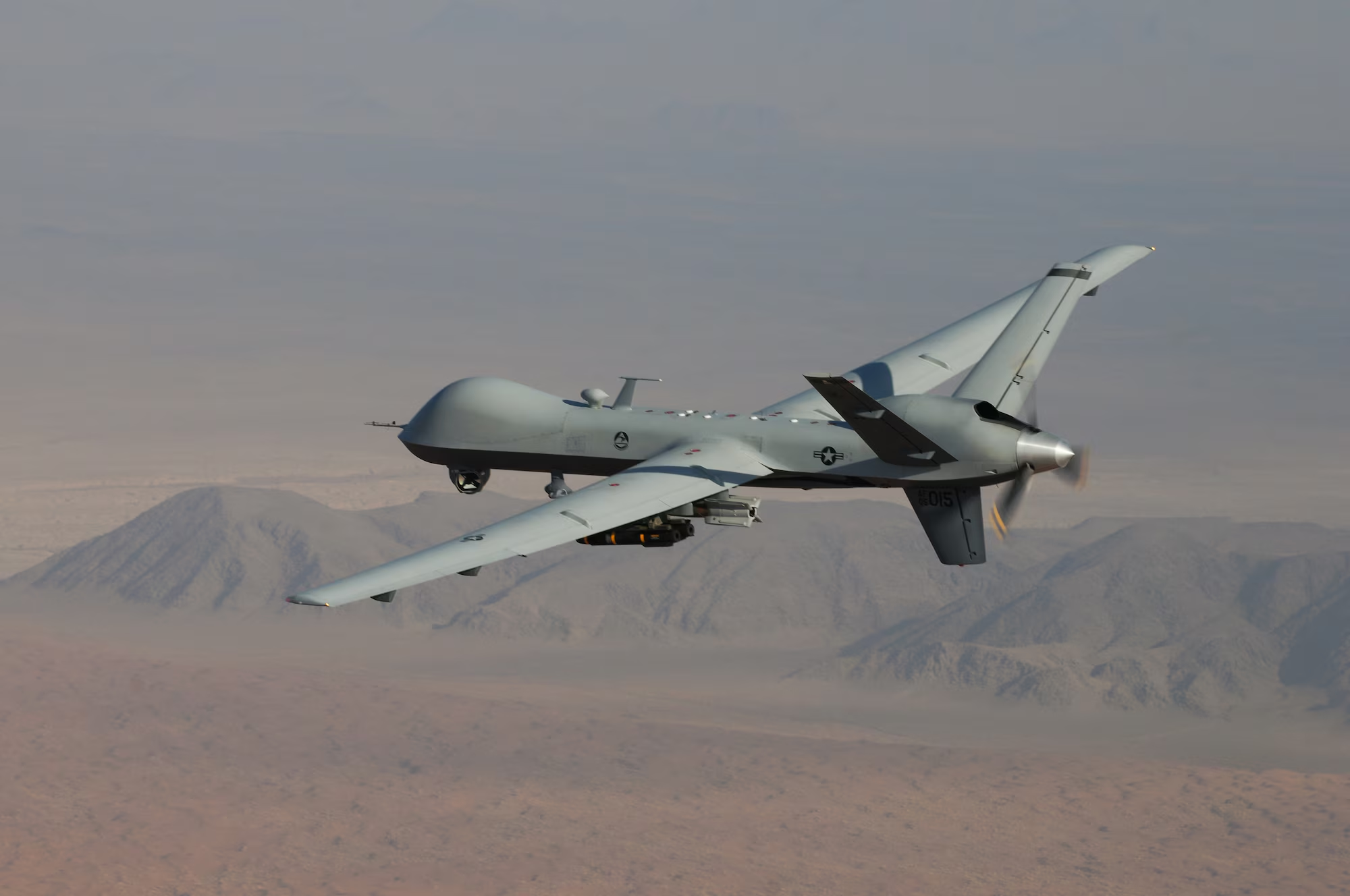
The MQ-9 Reaper is a long-endurance unmanned combat aerial vehicle developed by General Atomics Aeronautical Systems for the United States Air Force. Designed as a hunter-killer UAV, the Reaper combines persistent surveillance capabilities with precision strike weapons.
Since entering service in the mid-2000s, the MQ-9 has become one of the most widely used unmanned combat systems in modern military operations. It has been deployed extensively in intelligence, surveillance, reconnaissance (ISR), and targeted strike missions across multiple operational theaters.
1. Technology & Design
The MQ-9 Reaper is engineered as a medium-altitude long-endurance (MALE) unmanned aircraft, capable of remaining airborne for extended periods while carrying both sensors and weapons.
Structurally, the aircraft features a high-aspect-ratio wing optimized for endurance rather than high-speed maneuvering. The airframe uses lightweight composite materials to reduce weight and increase fuel efficiency.
Propulsion is provided by a turboprop engine mounted at the rear of the fuselage in a pusher configuration. This design improves sensor visibility in the forward field of view and reduces aerodynamic interference with surveillance equipment.
The Reaper’s sensor suite is centered on the Multi-Spectral Targeting System (MTS), which integrates:
- Electro-optical cameras
- Infrared sensors
- Laser rangefinders
- Laser target designators
These sensors enable the aircraft to track ground targets, provide real-time video intelligence, and guide precision weapons.
In addition to optical systems, some variants incorporate synthetic aperture radar (SAR) for ground mapping and target detection in poor weather or low visibility conditions.
The aircraft communicates with operators through satellite data links, allowing remote pilots to control the platform from ground control stations located thousands of kilometers away.
Armament includes:
- AGM-114 Hellfire precision missiles
- GBU-12 Paveway II
- GBU-38 JDAM
Multiple hardpoints beneath the wings allow the aircraft to carry combinations of sensors and munitions.
2. Role & Battlefield Function
The MQ-9 Reaper operates primarily at the tactical and operational levels of warfare, supporting ground forces and intelligence operations.
Its primary mission is persistent ISR combined with precision strike capability. Unlike traditional combat aircraft that operate on short sortie durations, the Reaper can remain on station for many hours.
Typical mission profiles include:
- Surveillance of suspected hostile activity
- Target tracking over extended periods
- Precision strike against identified targets
- Close air support for ground forces
- Border and maritime patrol
Within modern military doctrine, the Reaper functions as both a sensor platform and strike asset. It often identifies targets before engaging them directly or designating them for other platforms.
Because it can remain airborne for extended durations, the aircraft provides continuous monitoring of areas of interest, allowing commanders to maintain situational awareness over evolving operational environments.
3. Capabilities & Limitations
The MQ-9’s greatest capability is persistent surveillance combined with precision strike.
Its endurance allows it to monitor targets for long periods, enabling pattern-of-life analysis and real-time intelligence gathering.
Remote operation through satellite communications allows pilots and sensor operators to control the aircraft from secure locations far from the battlefield.
The aircraft’s ability to carry both sensors and weapons enables rapid transition from surveillance to engagement when necessary.
Additionally, the relatively lower operating cost compared to crewed combat aircraft makes the MQ-9 suitable for sustained operations.
However, limitations exist.
First, the aircraft operates at moderate speeds and lacks advanced maneuverability, making it vulnerable to modern air defense systems in contested airspace.
Second, reliance on satellite communications introduces potential vulnerabilities to electronic warfare or signal disruption.
Third, survivability against advanced fighter aircraft or integrated air defense systems is limited.
Fourth, the aircraft requires significant ground infrastructure, including control stations, satellite communications networks, and maintenance support.
Finally, operational use raises political and legal considerations related to remote warfare and targeted strike operations.
4. Strategic Impact
Strategically, the MQ-9 Reaper has played a major role in transforming modern military operations.
Its combination of persistent surveillance and precision strike capability enables a continuous intelligence-strike cycle, allowing forces to identify, monitor, and engage threats with minimal delay.
This capability has been particularly influential in counterterrorism and counterinsurgency operations, where long-duration surveillance is essential.
The widespread adoption of UAV platforms like the Reaper has also accelerated the integration of unmanned systems into military doctrine worldwide.
However, the rise of advanced air defense systems and contested airspace environments is prompting the development of next-generation unmanned aircraft designed for higher survivability and greater autonomy.
In long-term strategic terms, the MQ-9 represents a transitional platform between remotely piloted aircraft and future autonomous combat systems.
Its operational legacy lies in demonstrating how unmanned systems can extend surveillance coverage, reduce risk to pilots, and provide persistent strike capability across modern battlefields.

Comments are closed