

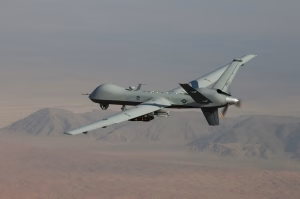
Drone swarm warfare refers to the coordinated deployment of large numbers of unmanned aerial vehicles (UAVs) operating collaboratively to overwhelm defenses, conduct reconnaissance, or deliver precision strikes. Unlike traditional UAV operations where individual drones are remotely piloted or controlled independently, swarm systems operate as distributed networks of autonomous or semi-autonomous agents.
These systems represent a shift in military doctrine from reliance on a small number of highly sophisticated platforms toward distributed, attritable, and algorithmically coordinated combat systems.
1. Technology & Design
Drone swarm systems are built around the concept of networked autonomy. Instead of centralized command directing every unit, each drone in the swarm operates using onboard sensors, communication links, and coordination algorithms that allow it to respond dynamically to changing conditions.
The core technological components typically include:
- Autonomous flight control systems
- Distributed communication networks
- AI-based coordination algorithms
- Sensor fusion and environmental awareness
- Modular payload integration
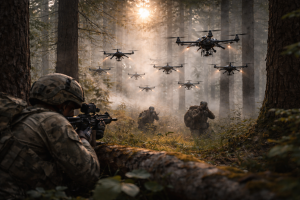
Each drone acts as a node within the swarm network, sharing data with nearby units to create a collective operational picture.
Communication between drones may occur through mesh networking, allowing the swarm to function even if some units are destroyed or jammed. This distributed architecture enhances resilience compared to centralized systems.
Swarm control software uses cooperative behavior algorithms inspired by biological systems such as flocks of birds or schools of fish. These algorithms allow drones to maintain formation, divide tasks, and dynamically adapt to threats or obstacles.
Payloads vary depending on mission requirements. Swarm drones may carry:
- Explosive warheads (loitering munitions)
- Electronic warfare modules
- Surveillance sensors
- Communications relays
Some systems emphasize low cost and expendability, allowing hundreds of units to be deployed simultaneously.
2. Role & Battlefield Function
Drone swarms operate primarily at the tactical and operational levels of warfare, though their strategic implications are significant.
Their primary mission is to overwhelm defensive systems through numerical saturation. Traditional air defense systems are designed to engage a limited number of incoming threats, but swarm attacks can present dozens or hundreds of simultaneous targets.
Typical swarm roles include:
- Air defense suppression
- Electronic warfare and jamming
- Precision strike against vehicles or infrastructure
- Reconnaissance and target designation
- Decoy operations to reveal enemy radar systems
Swarm systems are particularly effective against fixed installations such as radar sites, air defense batteries, and logistics hubs.
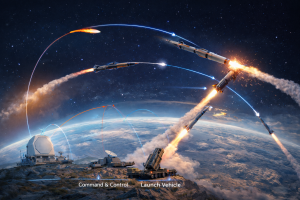
Deployment doctrine emphasizes distributed launch platforms, including trucks, ships, aircraft, or ground-based launch systems. Once deployed, the swarm disperses and approaches targets from multiple vectors.
The battlefield environment may include urban areas, maritime regions, and contested airspace where conventional aircraft face high risk.
3. Capabilities & Limitations
The most significant capability of swarm warfare is scalable combat mass. By deploying large numbers of inexpensive drones, commanders can impose significant defensive burdens on adversaries.
Swarm systems also offer operational resilience. Because each drone is relatively expendable, the loss of individual units does not compromise the overall mission.
Distributed sensing allows swarms to map environments and track targets collectively, improving situational awareness across large areas.
Swarm tactics can also exploit defensive weaknesses by attacking simultaneously from multiple directions.
However, limitations exist.
First, swarm coordination relies heavily on communications and algorithmic control. Electronic warfare or signal disruption can degrade swarm effectiveness.
Second, individual drones often carry small payloads. Significant destructive effects typically require large numbers of drones.
Third, swarm systems may struggle against advanced layered air defenses capable of engaging multiple targets rapidly.
Fourth, autonomous targeting raises legal and ethical concerns regarding human oversight and engagement rules.
Finally, swarm systems require sophisticated command software and integration to avoid collisions or inefficient task allocation.
4. Strategic Impact
Drone swarm warfare represents a major shift in the economics of military power.
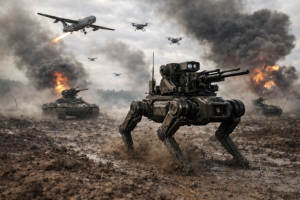
Traditional high-end platforms such as fighter aircraft or cruise missiles are expensive and limited in number. Swarm systems invert this model by emphasizing quantity over individual platform capability.
This change affects both offense and defense. Defenders must now prepare for large-scale drone saturation attacks, while attackers can project power using relatively inexpensive systems.
Swarm technologies also accelerate the role of artificial intelligence in warfare. Autonomous coordination and decision-making become essential as human operators cannot directly control hundreds of individual units in real time.
Strategically, swarm warfare lowers the barrier to entry for advanced military capabilities. Smaller states and non-state actors may acquire swarm technologies, altering regional security dynamics.
At the same time, counter-swarm technologies—including directed energy weapons, electronic warfare systems, and automated defense platforms—are rapidly evolving in response.
In the long term, drone swarms are likely to become a central element of modern military operations, representing a transition toward distributed, autonomous, and scalable combat systems that reshape how airpower and precision strike capabilities are deployed in future conflicts.

Comments are closed