
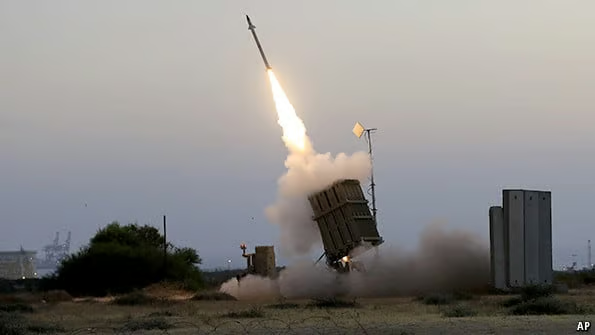
The Iron Dome is a short-range air defense system developed by Rafael Advanced Defense Systems in cooperation with Israel Aerospace Industries. Operational since 2011, it is designed to intercept rockets, artillery shells, and short-range unmanned aerial threats.
Iron Dome represents a layered, selective interception architecture optimized for high-volume, short-warning engagements in dense civilian environments.
1. Technology & Design
Iron Dome is engineered around three core components:
- Detection and tracking radar (commonly the EL/M-2084 multi-mission radar).
- Battle Management & Weapon Control (BMC) system.
- Tamir interceptor missile launchers.
The system’s design philosophy prioritizes rapid threat discrimination and cost-effective interception. Unlike traditional air defense systems that engage all detected projectiles, Iron Dome’s software calculates predicted impact points and engages only those assessed to threaten populated or critical areas. This selective engagement model preserves interceptor inventory and reduces cost-per-defense ratio.
The Tamir interceptor is a compact, highly maneuverable missile equipped with electro-optical sensors and proximity-fused warhead. It employs command guidance with terminal homing to intercept short-range ballistic trajectories.
The radar provides real-time tracking of incoming rockets and artillery rounds, feeding trajectory data to the BMC. The command system integrates threat analysis, interception decision logic, and launcher assignment within seconds.
Each battery is mobile, consisting of multiple launchers capable of carrying 20 interceptors each. Batteries can be rapidly redeployed to adjust defensive coverage based on evolving threat vectors.
Power generation and sustainment are terrestrial, using mobile support vehicles and networked communications infrastructure. The architecture allows integration into broader Israeli multi-layer defense systems, including:
- David’s Sling (medium-range threats)
- Arrow 3 (long-range ballistic missiles)
Technologically, Iron Dome’s innovation lies less in interceptor hardware and more in real-time discrimination algorithms and battle management integration.
2. Role & Battlefield Function
Iron Dome operates at the tactical and operational levels of homeland defense.
Its primary mission is protection against short-range rockets, artillery, and mortar threats. In the Israeli security environment, this includes projectiles launched from relatively close proximity, often with minimal warning time.
The system protects:
- Urban population centers
- Military bases
- Critical infrastructure
- Industrial facilities
Deployment doctrine emphasizes distributed battery placement around high-value zones. The system integrates into national command networks, enabling layered defense coordination.
In combat scenarios, Iron Dome reduces civilian casualties and infrastructure damage during rocket barrages. It also provides military decision-makers with operational breathing room by mitigating immediate civilian vulnerability.
Iron Dome does not function as an offensive system. It is purely defensive, though it indirectly enables offensive maneuver by reducing pressure on political leadership during active conflict.
The battlefield environment includes high-volume, low-cost projectile saturation scenarios. Threats are typically unguided rockets but increasingly include UAVs and short-range precision munitions.
3. Capabilities & Limitations
The system’s most significant capability is high interception success rates against short-range rockets threatening populated areas. Public data from multiple conflict cycles indicate interception effectiveness often reported in the 80–90% range against engaged threats, though figures vary by engagement context.
Selective targeting dramatically improves cost efficiency. By ignoring rockets projected to land in open areas, the system avoids unnecessary interceptor expenditure.
Mobility allows rapid repositioning to address shifting threat geography.
Scalability is moderate. Multiple batteries can operate concurrently, forming overlapping defensive zones.
However, limitations are structural.
First, interceptor cost exceeds the cost of many incoming rockets, creating an unfavorable cost exchange ratio in prolonged saturation campaigns.
Second, saturation remains a vulnerability. Large-scale simultaneous rocket barrages can overwhelm individual batteries if interceptor reload cycles are stressed.
Third, engagement range is limited to short-range threats. Iron Dome is not designed for long-range ballistic missile interception.
Fourth, each battery protects a defined coverage footprint. National-scale protection requires multiple deployments.
Fifth, while effective against ballistic rocket trajectories, evolving threats such as low-flying cruise missiles or complex UAV swarms require adaptation.
Finally, missile defense cannot provide absolute protection. Some projectiles may penetrate due to saturation, technical failure, or engagement geometry.
4. Strategic Impact
Strategically, Iron Dome has reshaped the deterrence calculus in asymmetric conflict environments.
By significantly reducing civilian casualties and infrastructure damage from rocket attacks, it diminishes the coercive leverage of non-state actors relying on indiscriminate bombardment.
This changes escalation dynamics. With reduced immediate civilian impact, political leadership gains greater flexibility in timing and scale of retaliatory operations.
Iron Dome also enhances societal resilience. Civil defense effectiveness strengthens national endurance during sustained conflict.
However, missile defense can also prolong conflict by reducing pressure for rapid ceasefire agreements, as immediate civilian damage is mitigated.
Internationally, Iron Dome has influenced air defense doctrine by demonstrating the viability of selective, software-driven interception at scale. It has informed short-range defense developments in other countries facing similar threat environments.
In long-term perspective, Iron Dome represents a model of layered homeland defense adapted to high-frequency, short-range threats. It does not eliminate rocket warfare but reduces its strategic effectiveness.
Its strategic significance lies in converting low-cost offensive saturation into a less decisive instrument—shifting the balance of psychological and political leverage in asymmetric conflict scenarios.



Comments are closed